
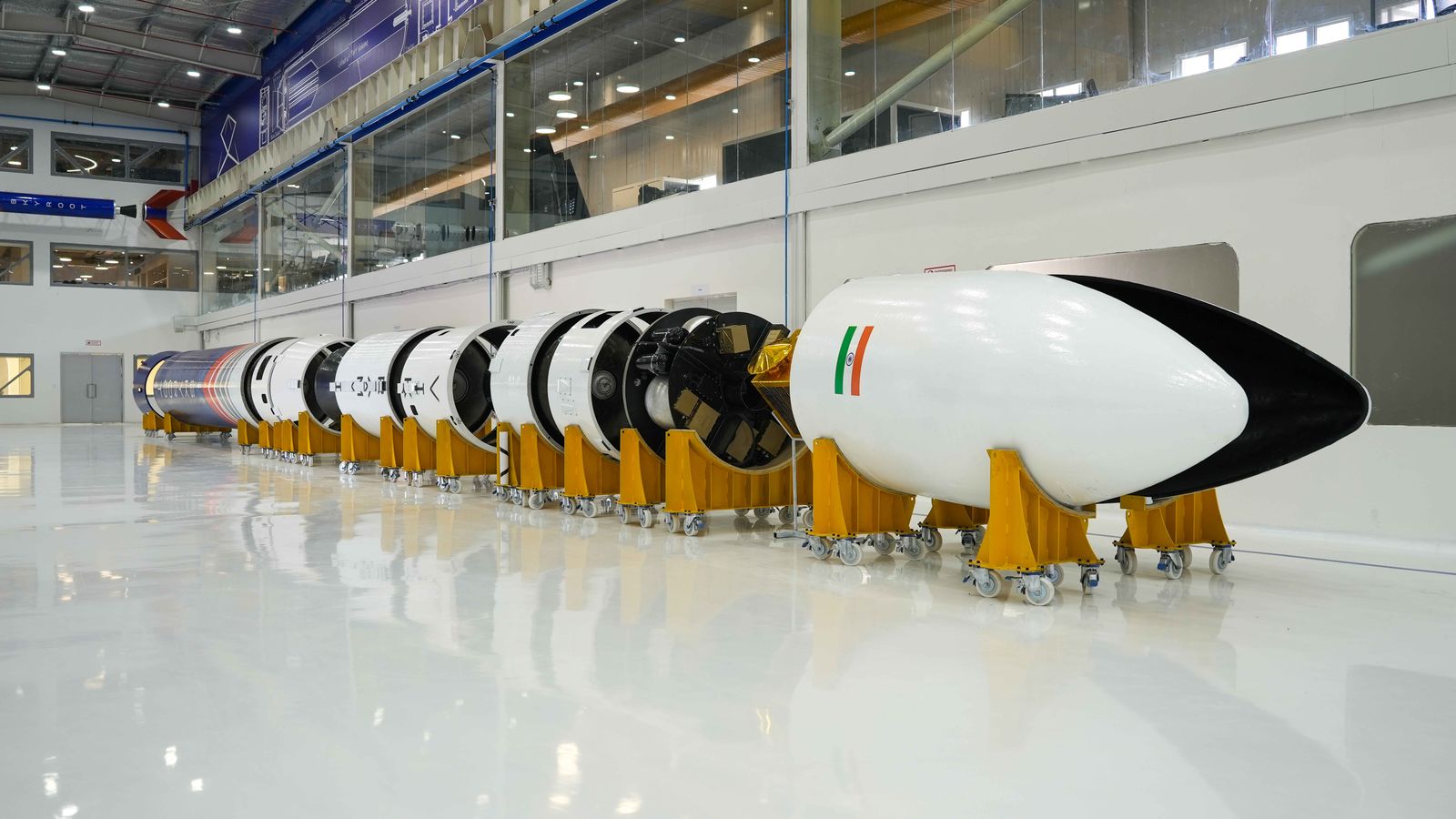
In November 2022, Skyroot Aerospace launched its sub-orbital rocket Vikram-S, becoming the first Indian private company to send a rocket into space. Today, Prime Minister Narendra Modi unveiled Skyroot’s first orbital launch vehicle, Vikram-I, capable of placing satellites into orbit—marking a major milestone for India’s private space industry.
The Prime Minister also inaugurated Skyroot’s Infinity Campus in Hyderabad via video conferencing. The state-of-the-art facility spans nearly 200,000 square feet and is designed for the development, integration, and testing of multiple launch vehicles. The campus has the capacity to build one orbital rocket every month, significantly strengthening India’s commercial launch capabilities.
Skyroot Aerospace and the Rise of Private Space Innovation
Skyroot Aerospace is India’s leading private space startup, founded by Pawan Chandana and Bharath Dhaka, both alumni of the Indian Institutes of Technology and former ISRO scientists who turned entrepreneurs. The Infinity Campus will serve as a hub for designing, developing, integrating, and testing launch vehicles under one roof.
Addressing the occasion, the Prime Minister said that Gen-Z engineers, designers, coders, and scientists are developing cutting-edge technologies in propulsion systems, composite materials, rocket stages, and satellite platforms. He noted that India’s youth are working in areas that were unimaginable just a few years ago.
He remarked that India’s private space talent is establishing a distinct global identity and added that for international investors, India’s space sector is fast becoming an attractive destination. “This spirit has given birth to the Private Space Revolution in India,” he said.
Growing Global Demand for Space Services
With the global demand for small satellites rising steadily, new companies are entering the space sector to provide satellite and launch services. The Prime Minister underlined that space has now emerged as a strategic asset, and that the global space economy is expected to grow manifold in the coming years—presenting a significant opportunity for India’s youth.
He emphasized that India possesses space capabilities that only a handful of countries in the world have, including expert engineers, a high-quality manufacturing ecosystem, world-class launch sites, and a mindset that encourages innovation.
India’s space program is known for being cost-effective and reliable, which is why global companies are eager to manufacture satellites in India, avail launch services from India, and enter into technology partnerships with Indian firms.
Policy Reforms and Institutional Support
Highlighting India’s journey, the Prime Minister said that from once carrying rocket parts on bicycles to developing the world’s most reliable launch vehicles, India has demonstrated that the height of dreams is determined not by resources but by resolve.
He noted that space today underpins communication, agriculture, marine monitoring, urban planning, weather forecasting, and national security. This has driven historic reforms in India’s space sector, with the government opening it to private innovation and preparing a new Space Policy.
To support this transformation, IN-SPACe was established to enable startups and industry to access ISRO’s facilities and technologies. Over the past six to seven years, India’s space sector has evolved into an open, cooperative, and innovation-driven ecosystem.
India’s Expanding Startup Ecosystem
When the space sector was opened to private participation, India’s youth—especially the Gen-Z generation—responded enthusiastically. Today, more than 300 space startups are shaping India’s space future. Many began with small teams, limited resources, and modest workspaces, driven by determination and ambition.
These developments are part of a broader startup revolution across India. Over the past decade, startups have emerged in diverse fields such as FinTech, AgriTech, HealthTech, ClimateTech, EduTech, and DefenseTech, with young innovators offering solutions across sectors.
India is now the world’s third-largest startup ecosystem. While startups were once concentrated in major cities, they are now emerging from small towns and villages as well. The country has more than 1.5 lakh registered startups, many of which have achieved unicorn status.
Looking Ahead: Research, Innovation, and Energy Security
The Prime Minister also highlighted that, just as space innovation was opened to private players, India is now moving towards opening the nuclear sector. He emphasized that private participation will play a key role in areas such as small modular reactors, advanced reactors, and nuclear innovation—strengthening India’s energy security and technological leadership.
He noted the establishment of the National Research Foundation to support modern research, and highlighted the “One Nation, One Subscription” initiative, which has made access to international journals easier for students across the country. The ₹1 lakh crore Research, Development, and Innovation Fund is expected to provide significant support to young researchers.
Additionally, more than 10,000 Atal Tinkering Labs have already been set up to foster innovation among students, with plans underway to establish 50,000 more labs in the coming years.