
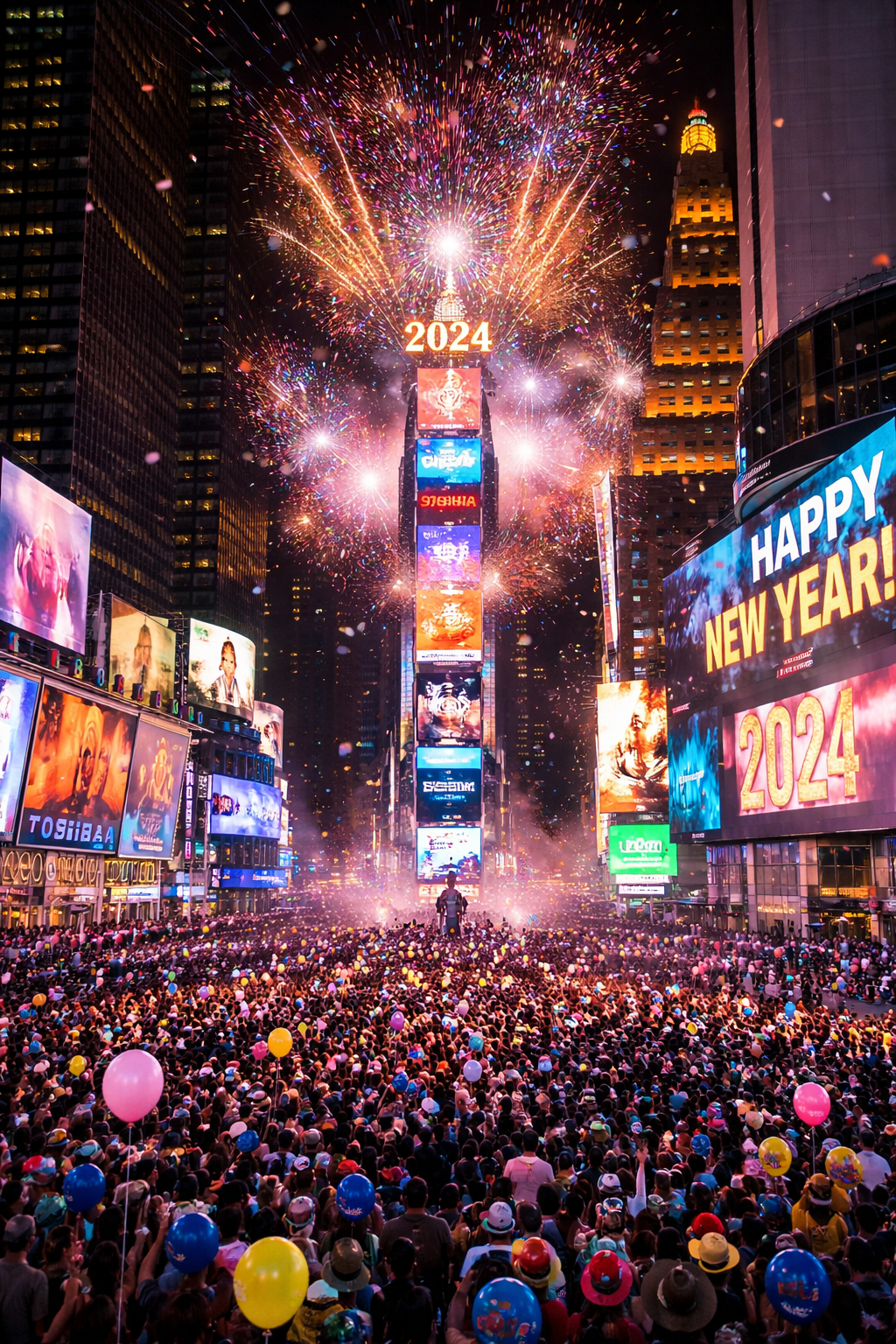
To herald the New Year, one of the world’s most iconic traditions is the dropping of the Time Ball at Times Square in New York, USA. Watched by millions across the globe on television and digital platforms, the Times Square Ball Drop has become a universal symbol of New Year’s Eve celebrations.
Every year, as the clock approaches midnight on December 31, a massive illuminated ball descends at One Times Square, marking the arrival of the New Year for audiences worldwide.
Origins of the Time Ball Tradition
The concept of a ball “dropping” to signal the passage of time dates back to 1833, when a time ball was installed atop England’s Royal Observatory at Greenwich. Dropped precisely at 1:00 PM each day, it allowed ship captains on the Thames to accurately set their chronometers.
Following the success at Greenwich, around 150 public time balls were installed worldwide. The tradition continues today in places such as the United States Naval Observatory in Washington, DC, where a time ball descends from a flagpole daily at noon.
Once a year, however, the world’s attention turns to Times Square, where the drop signals the exact stroke of midnight.
The First Times Square Ball (1907)
The first New Year’s Eve Ball was dropped in 1907 from the flagpole atop One Times Square. Measuring five feet in diameter, the original ball was made of iron and wood, fitted with 100 25-watt light bulbs, and weighed 700 pounds.
It was built by a young immigrant metalworker named Jacob Starr, whose company went on to manage the Ball Drop throughout much of the 20th century. The Ball has been lowered every year since 1907, except during World War II (1942–1943), when blackout restrictions were in place.
Evolution Through the Decades
- 1920: A 400-pound wrought-iron ball replaced the original.
- 1955: An aluminium ball weighing just 150 pounds took its place.
- 1981–1988: Red lights and a green stem transformed the Ball into an apple as part of the “I Love New York” marketing campaign.
- 1995: The Ball was upgraded with aluminium panels, strobe lights, and computer controls.
- 1998: This version was lowered for the final time.
For the millennium celebration, the Ball was completely redesigned, ushering in a new era of lighting and materials.
The Crystal Ball Era
In 2007, marking the 100th anniversary of the Times Square Ball Drop, traditional incandescent and halogen bulbs were replaced with modern LED lighting, dramatically increasing brightness and colour possibilities.
The owners of One Times Square later unveiled a much larger version of the Ball, weighing nearly six tons and measuring 12 feet in diameter. Made up of 2,688 Waterford crystal triangles and illuminated by 32,256 LEDs, this “Big Ball” is now a year-round attraction, sparkling above Times Square throughout the year.
The Modern Times Square Ball
The current New Year’s Eve Ball weighs 11,875 pounds, making it more than 17 times heavier than Jacob Starr’s original creation. It features:
- 2,688 Waterford crystal panels
- Over 32,000 LED lights
- A geodesic design engineered to withstand strong winds
According to its designers, the Ball is the only fine-crystal outdoor installation in the world and took a team of designers and builders 12 months to complete.
Each year, the Ball features a new theme. This year’s theme is the “Bowtie Crystal Ball”, with all 2,688 Waterford crystals newly installed.
Precision, Technology, and the Final Countdown
Preparations for the drop continue right up to midnight, with engineers and artists testing the system repeatedly for weeks. The Ball descends 77 feet in 60 seconds, meaning nearly 12,000 pounds of metal, crystal, and lights travel downward at over one foot per second, stopping precisely at midnight without incident.
Originally lowered by hand, the drop is now fully electronic, with the countdown controlled by an atomic clock in Colorado to ensure absolute precision.
The Ball is lowered along a 77-foot flagpole using a system of pulleys and counterweights. Throughout the night, the LED system displays a variety of colours and patterns, transforming the Ball into a dynamic light spectacle.
A Global Symbol of Renewal
From its roots as a maritime timekeeping device to its present-day status as a global broadcast event, the Times Square New Year’s Eve Ball Drop remains one of the most enduring and recognisable symbols of renewal, precision, and celebration—ushering in each New Year for the world to see.