
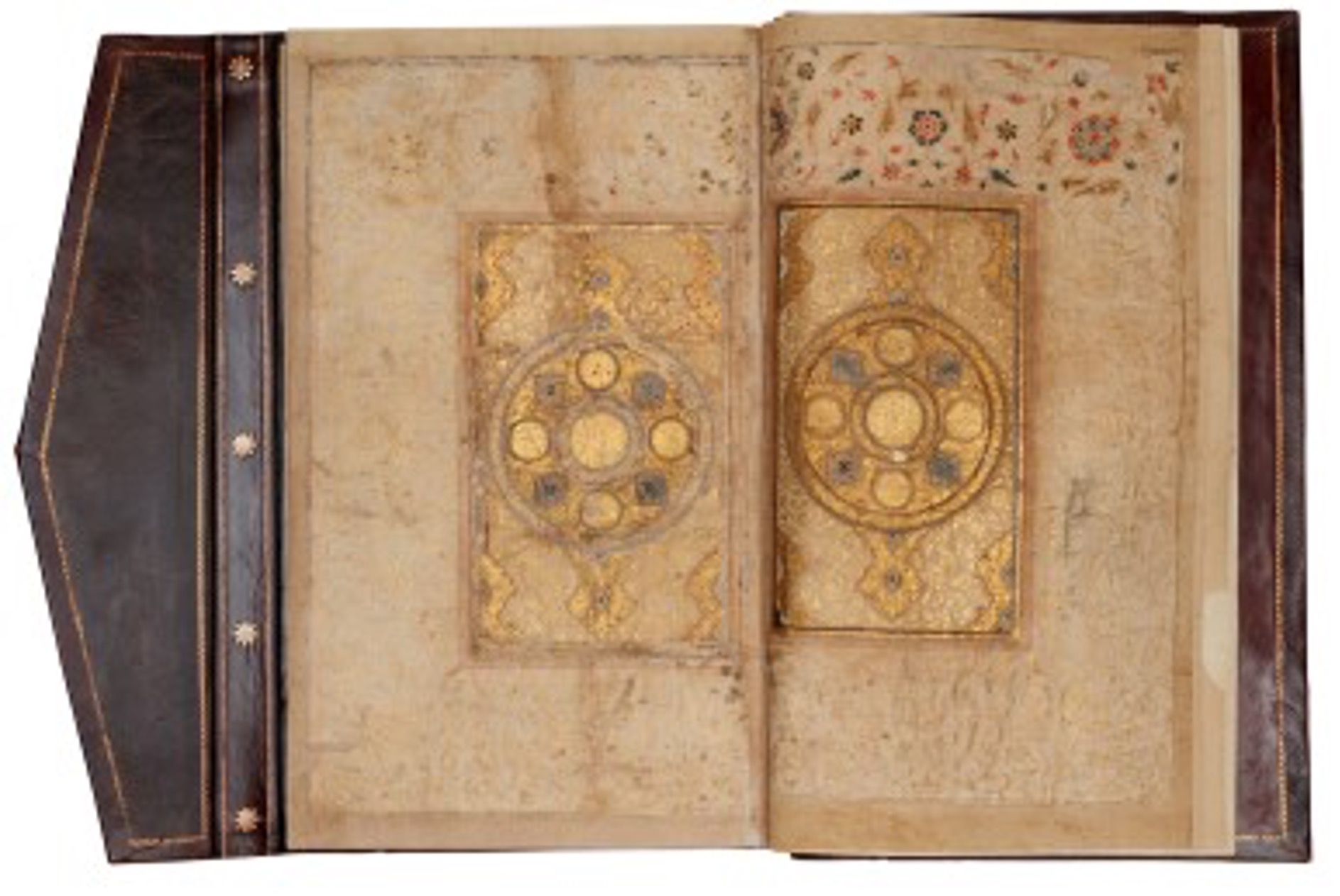
The library of Akbar the Great, the most celebrated Mughal ruler of India, once housed an extraordinary and rare manuscript of the Qur’an, accompanied by eight tafasir (commentaries). This magnificent work, bearing the combined title al-Itqan fi ‘Ilm al-Qur’an (Perfection in Qur’anic Science), stands as a remarkable testament to Islamic scholarship and Mughal patronage of learning.
Now, this historic Qur’an is set to go under the hammer. International auction house Sotheby’s has announced that the manuscript will be offered for sale, with an estimated price range between £40,000 and £60,000 — approximately ₹50–70 lakh.
This rare religious manuscript is written in Arabic and Persian on gold-sprinkled paper and comprises four volumes containing 173, 265, 204, and 284 leaves, along with fly leaves. The Qur’anic text, up to seven lines per page, is rendered in bold naskh script in black ink, while the interlinear Persian translation appears in nasta’liq script in red ink.
Each verse is separated by gold roundels with red and blue dots. The surah headings are elegantly inscribed in white on gold within polychrome illuminated panels, framed by intricate rules of gold, red, blue, and black. The borders are adorned with gold decorative motifs symbolizing life, growth, and fertility. The margins feature the text of al-Itqan fi ‘Ilm al-Qur’an in small black naskh script.
Key words and phrases are written in red ink and illuminated with gold. The manuscript bears imperial Mughal library seals and inspection inscriptions, indicating its presence in the royal collection. Each volume is bound in gilt-stamped brown leather, with leather doublures also stamped in gold. The Qur’anic text panel measures 10.8 × 7.8 cm, the text pane 41.4 × 23.4 cm, and each leaf 43.7 × 26.9 cm.
The Qur’an remained in the collection of a Middle Eastern ambassador to the United Kingdom until the early 1970s.
Originally bound as a single massive tome, the manuscript encompassed eight pivotal tafasir, representing the “perfection” of Qur’anic exegesis. These texts, written in Arabic and Persian, span five centuries of commentary up to Akbar’s reign, with a notable emphasis on authors influenced by Sufi thought.
The eight Tafsir are:
- Tafsir-i Qushayri
- Tafsir Mu’allim al-Tanzil
- Tafsir-i Kashshaf
- Tafsir al-Madarik
- Tafsir al-Baydawi
- Tafsir al-Jalalayn
- Tafsir-i Husayni
- Tafsir-i Muhammadi
On the final page, part of the Tafsir-i Husayni continues from the preceding folio. This page also bears several smudged seal impressions of Mughal librarians and inspection inscriptions, some still partially legible.
Among these, the most significant is the seal of Muhammad Yusuf, active during the late reign of Akbar and the early reign of Jahangir. The genealogical seal of Shah Jahan is also impressed at the center of the page, though much of it has faded. Above one inscription, in a different hand, appears the name ‘Emperor Alamgir’ (Aurangzeb). The two largest, though heavily smudged, seals are believed to belong to a librarian from the reign of Muhammad Shah in the early 18th century.
A particularly remarkable feature of this manuscript is the inclusion of the Tafsir-i Muhammadi, an obscure commentary authored by Shaykh Qutb al-Awliya’ Shaykh Hasan Muhammad Ibn Shaykh Ahmad Miyanji Chishti (923 AH / 1517–18 – 28 Dhu’l-Qa’da 982 / 20 March 1575). A Gujarati Sufi scholar, he served under the patronage of Sultan Mahmud Shah III (1543–54) and his successors in Ahmadabad, until Akbar annexed the province in 1573.
This tafsir is also mentioned in Ali Muhammad Khan’s Mirat-i Ahmadi, a history of Gujarat composed at Ahmadabad in 1750.