
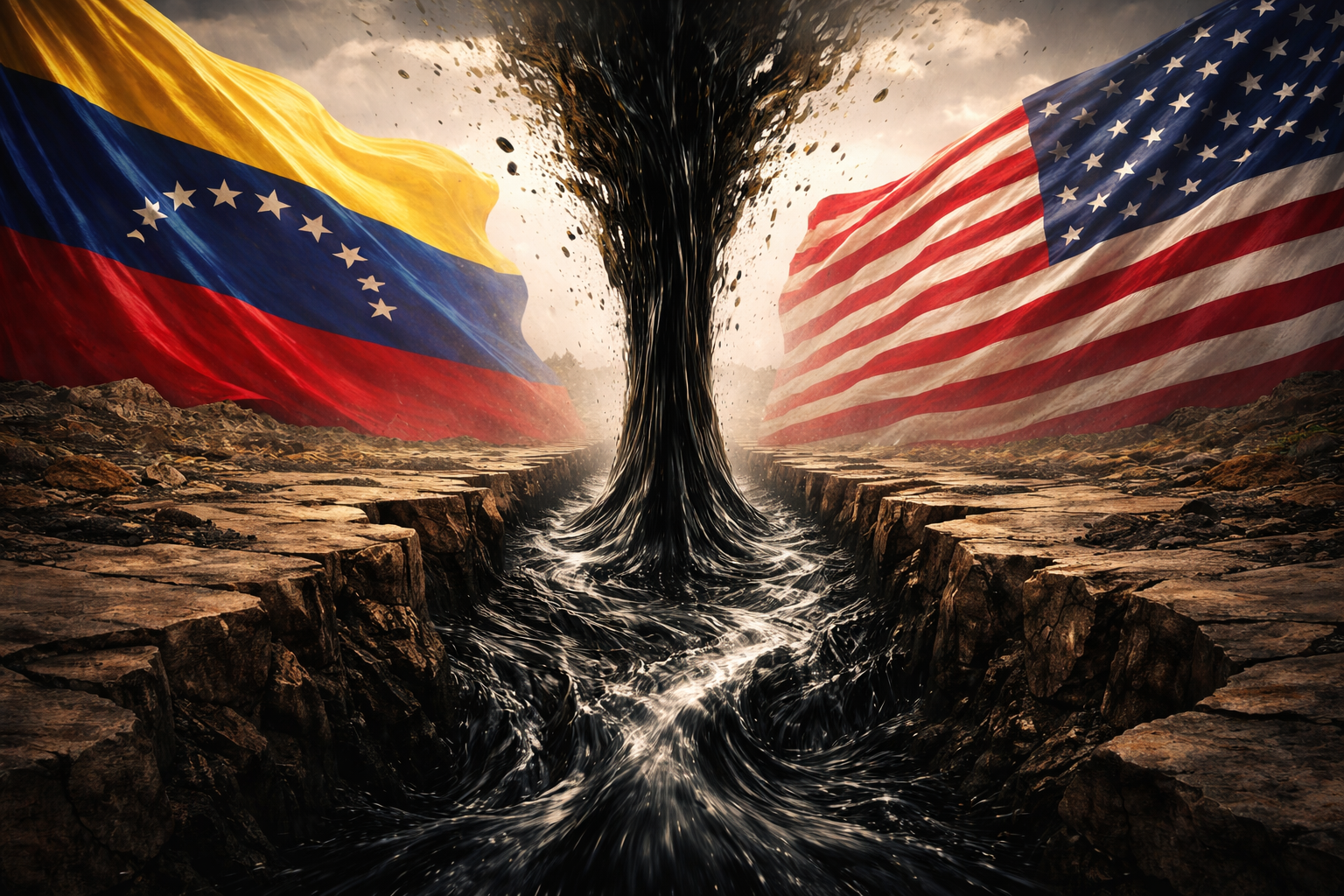
When US forces seized Venezuela’s president and the White House announced that Washington would temporarily “run” the country, the moment marked more than the collapse of a discredited regime. It signaled a decisive shift in how power is now exercised. Sovereignty was treated not as a legal principle but as a conditional privilege, revocable when strategic value outweighs restraint.
A line crossed
Few will mourn Nicolás Maduro. His rule hollowed out institutions, crushed opposition and presided over one of the largest peacetime migrations in modern history. Elections were manipulated, courts captured and dissent criminalized. Venezuelans voted for change and were denied it. These facts matter and they demand acknowledgment.
But they do not justify what followed. In January, US forces launched strikes inside Venezuela as claimed by the White House, captured the sitting president and his wife and allegedly transported them to New York to face criminal charges. Soon after, the US president declared that the US would administer Venezuela during a transition period and explicitly tied that role to rebuilding and exploiting the country’s oil industry. American oil companies, he said, would move in, repair infrastructure and begin producing value.
This was not an offhand remark. It clarified the logic of the intervention. What unfolded was not multilateral democracy promotion or humanitarian protection. It was unilateral power exercised openly, justified through shifting rationales and anchored by resource control.
Oil moves from subtext to policy?
Venezuela’s wealth explains the fixation. The country holds the world’s largest proven oil reserves and some of South America’s largest gold deposits. Those assets once financed social programs under Hugo Chávez, then locked the country into a brittle, oil-dependent model that collapsed under mismanagement and falling prices. Oil shaped Venezuela’s internal failures and it has long shaped external interest as well.
Sanctions targeted oil revenues. Arbitration disputes revolved around oil assets. Relief from sanctions were repeatedly offered in exchange for electoral concessions, which tied to oil production. Now oil has moved from subtext to centerpiece. When the president said American companies would enter Venezuela during a US-run transition, ambiguity disappeared.
The administration has offered a carousel of justifications. Drugs. Terrorism. Migration. Democracy. None stands up under sustained scrutiny.
Venezuela is not a major source of fentanyl entering the US, sources say. The US government assessments show the synthetic opioid is produced primarily in Mexico and trafficked across land borders. Venezuela functions largely as a transit route for some cocaine shipments, most of which move toward Europe. Yet the administration authorized dozens of naval and aerial strikes on alleged smuggling vessels, killing more than a hundred people, often without transparent legal justification.
Maduro was illegitimate. So was the method. Strategy or spectacle?
Migration has also been weaponized rhetorically. Millions of Venezuelans have fled economic collapse and repression, overwhelming neighboring states. But presenting that exodus as a deliberate campaign against the US, or as grounds for abducting a foreign head of state, strains credibility.
As for democracy, the contradiction is stark. A democratic pathway existed, however fragile. Opposition forces amassed overwhelming evidence that they won the 2024 election, only to be blocked by courts and institutions loyal to Maduro. Regional and international pressure could have been coordinated around that outcome. Instead, Washington acted alone, bypassing allies, Congress and multilateral institutions. There was no shared mandate and no articulated plan beyond force. Where was the “Rule-based International Order”, or the United Nations Charter Article 2 (4)?
The intervention was not designed for legitimacy. It was designed for spectacle. And that spectacle was aimed largely at domestic audiences. The administration communicated through social media posts and friendly television platforms, not through sustained engagement with Congress or the public. Multiple rationales were offered in rapid succession, often contradicting one another. Venezuelans appeared not as citizens to be supported but as symbols within a narrative centered on crime, borders and dominance.
The justifications don’t add up
This inward-facing posture explains the most troubling feature of the episode: vagueness. How would the US “run” Venezuela? Through what authority? For how long? With whose consent? No answers were provided. The absence was revealing. Legitimacy is being treated as unnecessary.
International reaction reflected that unease with condemnation. While few governments defended Maduro, many warned that abducting a sitting head of state and administering another country by force set a dangerous precedent. The United Nations secretary-general expressed alarm that basic rules of international law appeared to have been discarded. Latin American leaders cautioned that unilateral military action risked destabilizing the region. Even allies emphasized that any transition must be peaceful and lawful.
Opposing Maduro does not require endorsing the method used to remove him. The two are not interchangeable.
But if we look carefully into the events, no company illustrates the deeper structure of this moment more clearly than ExxonMobil. The entanglement of US diplomacy and oil capital is not incidental. Rex Tillerson, who led ExxonMobil for a decade before serving as secretary of state, exemplified a revolving-door culture in which energy interests and foreign policy have long informed one another — shaping assumptions that persist even when personalities change.
Exxon and the system that outlasts presidents
Nearly two decades before US forces entered Venezuela, Exxon exited the country after refusing to accept Chávez’s demand that foreign oil projects operate under majority state control. Unlike other firms that stayed and adapted, Exxon withdrew and sued. International arbitration ultimately ordered Venezuela to pay more than $1 billion in compensation for nationalized assets. That episode is often remembered as a discrete corporate dispute. In hindsight, it reads as a template.
Exxon did not need to remain in Venezuela to preserve its interests. International legal regimes insulated it from total loss even as the country descended into dysfunction. While sanctions and mismanagement hollowed out Venezuela’s oil sector, Exxon shifted capital elsewhere, including to neighboring Guyana, where vast offshore discoveries were developed under far more favorable terms. The company absorbed delay, confident that legal protections and geopolitical realignment would eventually reset access. Meanwhile, Venezuela also claimed that much of the offshore oil that Exxon struck in Guyana lies beneath the waters over which Venezuela claims sovereignty, further complicating the matter and escalating the disputes.
This re-sparked tensions between Venezuela and Guyana in early 2024 over the long-disputed Essequibo region. On Jan. 7, Venezuela announced plans to hold elections in “Guyana Esequiba,” which comprises about two-thirds of Guyana and on March 1, a Venezuelan navy vessel confronted ExxonMobil-linked oil ships operating in Guyana’s offshore Stabroek block. Guyana mobilized its security forces, filed diplomatic protests and sought international support, while Venezuela said the incident occurred in disputed waters. On March 6, Guyana asked the International Court of Justice to order provisional measures to block Venezuela from including Essequibo in elections scheduled for May 25.
That patience now looks prescient. When the US president announced that American oil companies would move into Venezuela during a US-administered transition, he was not inventing a new role for firms like Exxon. He was completing a cycle in which corporate capital exits during assertions of sovereignty, recovers losses through arbitration and returns when sovereignty collapses under pressure.
Method to the madness
This is not conspiracy. It is structure. Exxon did not need to lobby for military intervention to benefit from it. The system already does that work. Courts protect corporate assets. Sanctions weaken state capacity. Military power redraws access. The risks are borne by citizens; the rewards accrue to actors positioned to endure instability and reenter later. The danger lies not only in Venezuela but in what this normalizes. If sovereignty can be overridden when a state is weak and resource-rich, others will draw lessons. In a multipolar world, precedents travel fast.
Supporters argue that Venezuela’s suffering demanded decisive action. That claim deserves to be heard and rejected. History is crowded with interventions justified by urgency that produced instability and prolonged dependence. Venezuela’s institutions did not vanish with Maduro’s capture. Armed groups remain active. Loyalties within the military are complex. Managing the aftermath would require sustained external involvement of the very kind long denounced.
The indictment and warning
There is also the question of consistency. Washington maintains relationships with governments whose democratic credentials are thin, provided they align strategically. Selective intervention weakens claims of principle. What emerges is not democratic rescue but extractive intervention of military force, legal exceptionalism and economic interest converging. Oil is not the only motive, but it is the organizing incentive.
The warning follows. If the US treats law as optional and sovereignty as conditional, it accelerates the erosion of the very order it once defended. If it confuses spectacle with strategy and power with legitimacy, it trades restraint for instability. Venezuela needed democratic change. Democracy imposed at gunpoint and tied to resource extraction is not restoration. It is replacement.
The US long insisted that might does not make right. In Venezuela, it acted as if it does. That choice will echo far beyond Caracas, reshaping how power is judged and how easily law is discarded when oil lies beneath the ground. In the end, this intervention may remove one man. Unless restraint returns, it risks entrenching a far more dangerous idea – that power alone confers the right to rule.