
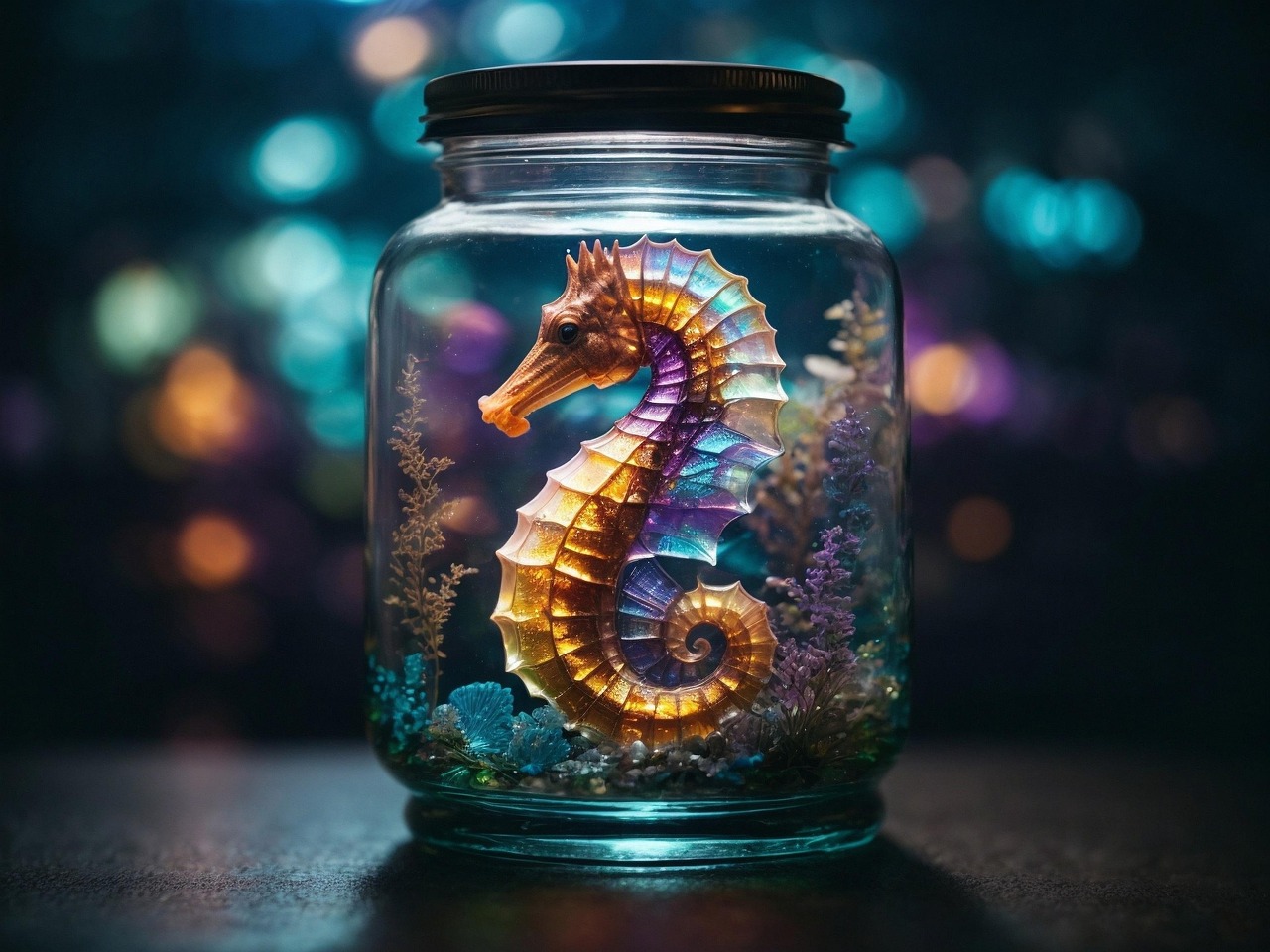
Have you ever seen a tiny fish shaped like a horse that swims upright? It is called the seahorse, named for its unique body structure.
Its oddities do not end with its appearance. Besides having a snout like a horse and a tail like a monkey, the seahorse has one of the strangest reproductive systems in the animal kingdom: the male becomes pregnant. The male seahorse has a pouch similar to that of a kangaroo. After mating, the female deposits her eggs into the male’s pouch, where he fertilizes and incubates them until they hatch. The pouch provides a protected, nutrient-rich environment, complete with a placenta-like structure similar to a mammalian uterus, for the developing embryos.
When the babies are ready, the male “gives birth” to hundreds of tiny, fully formed seahorses. At the end of the gestation period, he expels the young from the pouch.
Seahorses are an endangered species, with their population declining rapidly due to exploitation by unscrupulous traders of marine products. In traditional Chinese medicine, seahorses are used to treat a variety of ailments.
Despite a ban on this exotic fish in India, illegal trade continues unabated. In April, 50 kg of seahorses worth ₹15 lakh were seized in Ramanathapuram, while another five kilograms were confiscated in Siliguri in October this year.
In the mid-1990s, India emerged as a major global supplier of dried seahorses for traditional medicine. According to a 1999–2000 survey, an average of over 3.5 lakh seahorses were caught, dried and sold illegally each year. A large number were caught during trawl fishing, accounting for 58% of the average catch. Over 80% came from the Indian Ocean and the Bay of Bengal, with Puducherry, Tamil Nadu and Kerala being the main regions of capture.
The average minimum annual export was estimated to be around 13 million tonnes of seahorses, primarily exported to Hong Kong, Malaysia and Singapore. Domestic consumption in India—either for marine aquaria or as curios—was almost negligible.
In 2001, all seahorse species (genus Hippocampus) in India were placed under Schedule I of the Wildlife Protection Act, 1972, banning all extraction and trade nationwide. Prior to this ban, a study estimated that 16.8 million seahorses had been caught.
In 2002, seahorses were listed internationally under CITES Appendix II, requiring that all exports be legal and not harmful to wild populations. Seahorses became the first genus of marine fishes to be included under CITES.
Illegal seahorses predominantly originate from Africa, Asia and Latin America, with China as the primary destination. Millions of seahorses representing more than 30 species are traded among over 80 countries, mainly to supply traditional Chinese medicine, as well as the aquarium and curio trades.
Export bans have largely pushed the trade underground rather than eliminating it. As recently as June 2025, police in Ecuador seized a package containing nearly 3,000 seahorses believed to be en route to China and Vietnam via Colombia. The Peru–China–Hong Kong route is considered one of the busiest corridors for illegal seahorse trafficking.
In India, Tamil Nadu (including Puducherry) has emerged as the state with the highest seahorse catch, accounting for a median of 75% of annual captures, followed by Odisha (16.8%) and Andhra Pradesh (3.4%). About 89% of seahorses were caught using non-selective fishing gear such as trawls and seine nets, particularly drag nets operating along the seabed in shallow waters of the Palk Bay region.
Preserving seahorses is vital for conservation because they highlight the need to protect diverse marine habitats such as seagrass beds, mangroves and coral reefs. Their presence indicates a healthy ecosystem, as they regulate populations of small organisms and serve as indicators of water quality. Protecting seahorses and their habitats benefits many other marine species.
Seahorses are highly sensitive to environmental changes, making them effective indicators of overall ecosystem health. Their decline can signal pollution or habitat degradation. As predators of small bottom-dwelling organisms and crustaceans, they play a crucial role in maintaining balance within the marine food web.
Researchers from Project Seahorse reported that nearly 5 million specimens were seized globally between 2010 and 2021, valued at over $21 million—a figure believed to represent only “the tip of the iceberg.” China accounted for 40% of seizures, followed by Peru at 17% and Vietnam at 14%.