
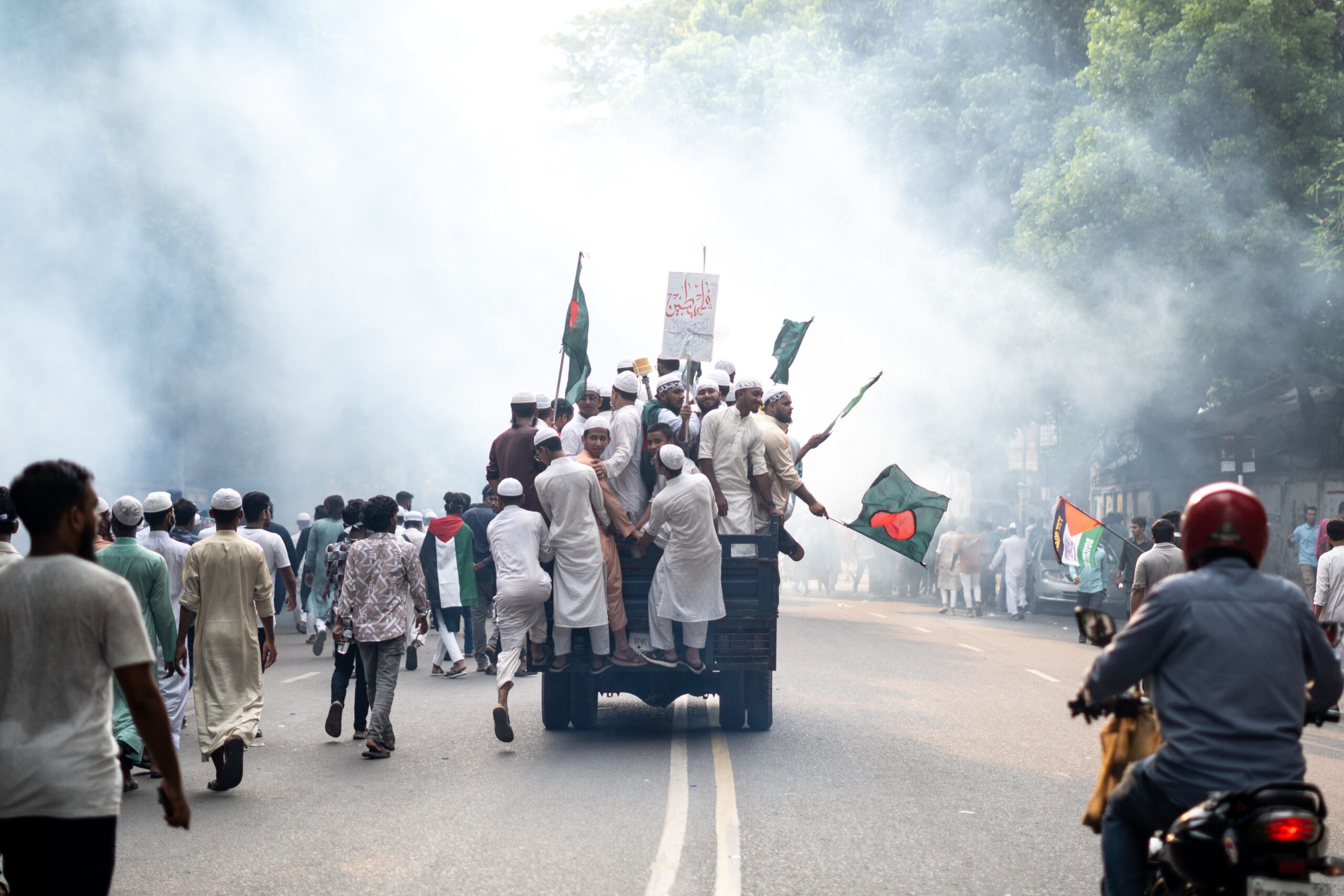
India must closely watch the growing political unrest in neighbouring Bangladesh, where the killing of youth leader Sharif Osman Hadi, anti-India protests, attacks on media organisations and violence involving religious minorities have added to concerns about the country’s political stability.
The developments are particularly significant for India because of the deep historical, economic and strategic ties between the two countries, as well as Bangladesh’s position in a region where China and Pakistan are also seeking influence.
The immediate trigger for the latest unrest was the killing of Sharif Osman Hadi, a prominent leader of the movement that helped oust former Bangladesh Prime Minister Sheikh Hasina.
Hadi, a spokesperson for Inqilab Moncho and a prospective parliamentary candidate, was shot by masked attackers in Dhaka on December 12, 2025. He was taken to Singapore for treatment but died from his injuries on December 18.
His death triggered protests across Bangladesh, with demonstrators demanding the arrest and prosecution of those responsible. The killing also intensified anti-India sentiment among some groups, with allegations that suspects had escaped to India.
Such allegations remain politically sensitive and should not be treated as established fact until supported by the investigation.
Hasina herself has been living in India since fleeing Bangladesh on August 5, 2024, following weeks of student-led protests that brought an end to her 15 years in power.
In November 2025, Bangladesh’s International Crimes Tribunal convicted Hasina in absentia of crimes against humanity and sentenced her to death. Her presence in India has consequently become another major source of tension in India-Bangladesh relations.
Hadi’s killing has added further volatility to an already complicated political environment.
Inqilab Moncho has continued to organise demonstrations demanding justice for Hadi, while protesters have also raised anti-India slogans and demanded the return of people they allege are sheltering in India.
For New Delhi, the challenge is to monitor these developments carefully without becoming unnecessarily embroiled in Bangladesh’s domestic political struggle.
The unrest goes well beyond a conventional law-and-order problem.
Following Hadi’s death, mobs attacked the offices of two of Bangladesh’s best-known newspapers, The Daily Star and Prothom Alo. The attacks forced journalists to seek safety as buildings were vandalised and set on fire.
The newspapers had been accused by some protesters of being sympathetic towards India and the former Hasina government.
Such attacks have intensified concerns over press freedom, political intolerance and the ability of Bangladesh’s interim authorities to maintain order during a sensitive political transition.
The rise and renewed political activity of Islamist organisations are also being closely watched.
Jamaat-e-Islami, Bangladesh’s largest Islamist political organisation, opposed the country’s independence from Pakistan during the 1971 Liberation War. Its role and that of other Islamist political forces remain important factors in Bangladesh’s changing political landscape.
For India, Bangladesh’s stability has major strategic implications.
The two countries share a border of more than 4,000 kilometres, while cooperation between them extends across trade, connectivity, energy, security and management of shared rivers.
Any prolonged instability in Bangladesh could therefore have consequences well beyond its borders.
Relations are also affected by the history of Bangladesh’s creation. India supported the Bengali independence movement and intervened militarily during the 1971 war that resulted in the creation of Bangladesh from what was then East Pakistan.
Today, Pakistan’s evolving relationship with Bangladesh is being closely watched in New Delhi, particularly as diplomatic and security contacts between Dhaka and Islamabad develop.
China is another important factor. Beijing has built extensive economic, infrastructure and defence ties with Bangladesh, giving developments in Dhaka a wider geopolitical significance.
But India’s concerns are not limited to geopolitics.
Violence involving Bangladesh’s Hindu minority has generated considerable concern in India.
One particularly disturbing case was the lynching of Hindu garment worker Dipu Chandra Das in Mymensingh after allegations that he had insulted Islam. His body was subsequently burned, and Bangladeshi authorities arrested a number of people in connection with the killing.
The incident provoked protests in India and intensified demands that Bangladesh’s authorities provide greater protection to religious minorities.
Congress leader Priyanka Gandhi Vadra described the killing as “extremely alarming” and called upon the Indian government to raise the safety of Hindu, Christian and Buddhist minorities with Bangladesh.
India’s Ministry of External Affairs also condemned the killing and urged Bangladeshi authorities to identify and punish those responsible.
At the same time, the unrest has produced competing narratives in both countries.
Bangladesh has expressed concern over demonstrations near its diplomatic missions in India, while New Delhi has rejected some Bangladeshi media reports about protests outside diplomatic premises as exaggerated or misleading.
These disputes underline how rapidly domestic unrest in Bangladesh can spill over into bilateral relations.
The interim government headed by Nobel laureate Muhammad Yunus has repeatedly promised action over Hadi’s killing.
After Hadi was shot, Yunus condemned the attack and ordered law-enforcement agencies to conduct a swift investigation. He warned that violence aimed at disrupting Bangladesh’s political transition would not be tolerated.
Following Hadi’s death, protests spread across Dhaka and other cities, increasing pressure on the government to identify his killers.
Bangladeshi authorities launched a manhunt and released information about suspects while offering a financial reward for information leading to arrests.
Civil society organisations have also demanded a transparent investigation into Hadi’s killing as well as investigations into attacks on newspapers, cultural organisations and other institutions.
The UN human rights office has similarly called for accountability and an impartial investigation into the killing.
The wider concern is that Hadi’s assassination has become a focal point for several existing tensions — anger against the former Hasina government, anti-India sentiment, religious divisions, distrust of state institutions and competing visions for Bangladesh’s political future.
For India, this creates a difficult diplomatic challenge.
New Delhi has legitimate security and strategic interests in a stable Bangladesh, but overt involvement in its neighbour’s internal political contest could deepen the very anti-India sentiment that India seeks to contain.
India therefore has reason to closely monitor violence against minorities, threats to its diplomatic interests, cross-border security concerns and the direction of Bangladesh’s foreign policy while maintaining diplomatic engagement with Dhaka.
Bangladesh itself faces an equally consequential challenge.
The country emerged from the 1971 Liberation War with secularism, nationalism, democracy and social justice among the principles that shaped its constitutional identity. The extent to which those principles will continue to define Bangladesh remains an important issue in its current political transition.
The murder of Sharif Osman Hadi and the unrest that followed demonstrate how fragile that transition can become when political violence, religious tensions and geopolitical rivalries converge.
India cannot afford to ignore instability in a country with which it shares geography, history and extensive strategic interests.
But neither can every development in Bangladesh be viewed solely through an India-Pakistan or India-China prism.
Ultimately, Bangladesh’s political direction will be determined by Bangladeshis themselves.
For India, the more sustainable objective is a stable neighbour in which democratic institutions function, political differences are settled without violence, religious minorities are protected and bilateral disagreements are managed through diplomacy rather than confrontation.