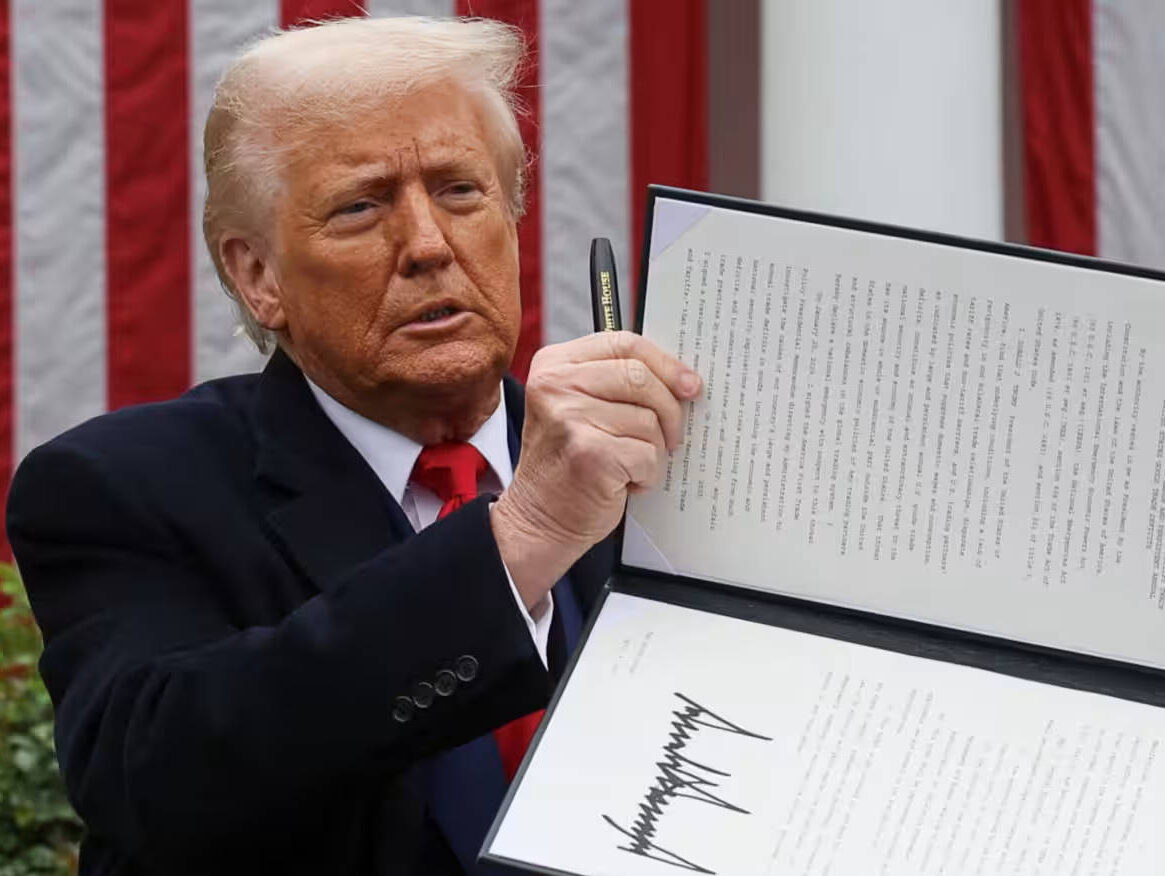
True to his words Donald Trump has started making it tougher for the immigrants to enter into America.
This has led to widespread panic among number of skilled workforce and qualified academics in India who have US as their major destination in mind, as their future place of work.
This clearly goes against what president Donald Trump has in mind when he talks of making America great again. He wants America run by American workforce benefitting American economy rather than they being replaced by immigrant workforce from different parts of the world sending money out of America.
True talented Indians are sought after by American companies who are ready to pay them well primarily because they are talented professionally and are skilled workers and academics.
The new U.S. restrictions include, high H-1B application fees (approaching $103,000), fixed four-year caps on student visas, and shortened grace periods.
Clearly the toughening of US stand is going to force Indian immigrant who looked for job in the US to seek it elsewhere in the world like Australia, UK and Canada, primarily the English speaking nations.
While the Indian Ministry of External Affairs has formally raised concerns with Washington, emphasizing that sudden restrictions and fee hikes risk severe humanitarian consequences and family disruptions while hurting bilateral tech ties.
But even though it is a globalised world Indians cannot and should not blame America for doing what it is doing because truly large number of immigrants including Indians are being employed by American companies taking lucrative salaries replacing the Americans.
No country naturally can accept a situation like that where its own population remains unemployed and the foreign immigrants to the country have all the available jobs.
Therefore Donald Trump is well within his rights to set right the present situation of immigration in US.
Around 50.2 million to 53.3 million people living in the U.S. were born in another country.
This group makes up between 14.8% and 15.8% of the total U.S. population.
It is not only the availability of jobs though work is the major reason why people immigrate to the US but high standard of living and basic freedom , safety and security which makes many persons immigrate to the US.
Educated Indians particularly belonging to the upper class usually have ambitions of studying and settling down in the US and they are the ones clearly hit by any tightening of immigration laws by the US.
The government of India however wants to reverse the brain drain of highly qualified young men and women of the coubtry instead of serving in the country preferring to serve the US, primarily due to high pay compared to India.
One way is to expand Global Capability Centres (GCCs) in India—as an opportunity to absorb and lure back top-tier engineering talent.
The hike in visa fee will virtually block a large number of persons dreaming to work in America. They must now have deep pockets to pay the visa fee.
If they belong to a class which can easily cough up $,100,000 as a visa fee, they would they be lining up for immigrating to America and work there.
The fee will be imposed on highly skilled foreign workers in the areas of technology, education and research.
The fee imposed last year could not be collected as a US judge ruled that it was illegal which decision is under review.
Now Trump has issued orders to the U.S. Department of Homeland Security to adopt regulations making it permanent.
The proposed rule to pay $103,265 fee could be finalized by the end of the year.
Nearly 65,000 visas are offered annually under the H-1B program to hire specialist foreign workers. Twenty thousand additional visas are offered to workers with advanced degrees.
One of the major reasons for making it difficult to get H-1B visa was because the Trump administration felt that this route was used by the American companies to hire cheap foreign labour replacing American workforce.
The companies however argue that they do not get required qualified workers in the US and therefore have to seek the best available talent from abroad.
The Trump administration feels that restricting entry into the country of foreign nationals is clearly out of the purview of the courts jurisdiction.
With stricter immigration control, H1-B visa registrations have been drastically dropping drastically during the past few years.
The new visa selection process also favours only highly skilled and better paid workers.
Soon after this announcement Harvard University has recommended that international students enrolled in the on-campus programme return to the United States before the new federal immigration rules took effect.
The Trump administration also wants to replace “duration of status” with fixed admission periods for F-1, J-1, and I (foreign media and journalists) visa holders, which implies that foreign students, scholars, and exchange visitors can stay in America only as long as they maintain their academic status.
The rule states that if an international student or scholar (or dependent), including one who was physically present in the US on the effective date, leaves America and re-enters after September 15, they will be subject to new rules upon their re-entry.
Columbia University has set a deadline for international students to return by September 8.Ohio State University, Georgetown, George Washington (GW), and the University of Chicago have also issued guidelines and warned foreign students to plan their return according to the new rules of DHS.
H-1B families, international students and other immigrants will face new immigration filing requirements beginning Sept. 15, when the U.S. government introduces revised forms and implements broader changes to the rules governing the length of stay for certain visa holders.
Under the new system, F-1 and J-1 students and exchange visitors will generally be admitted for a fixed period rather than for the duration of their program.
For international students, the change means immigration status will require closer attention to the authorized admission period shown on their immigration records.
A program extension through a school does not, by itself, necessarily provide the same immigration authorization under the new framework. Students seeking to remain beyond their authorized period may need to file an extension-of-stay application with USCIS.
Indian nationals comprise a large share of both international students and H-1B workers in the United States.
When applying for an H-1B visa, you will have to prove that you have a specific job offer from the U.S.
The job offered must require the applicant’s specific skills, in particular a U.S. bachelor’s degree
The applicant’s expected salary must not be lower than the amount paid to employees with comparable experience and qualifications, and their hiring must not adversely affect that group of employees.
But as already the matter of visa fee hike is in Court, not having had a Congressional assent and only being a presidential diktat.
It is therefore possible that the regulation will be repealed, modified, or reversed by a new administration in the future.
Actually the visa fee will place greater burden on small and medium-sized businesses who want to hire cheap foreign workforce.
However as intended the tougher immigration rules will perforce make American employers to go in for American workforce and if that force is not upto the mark or qualified then the American state has to decide how to improve the standard and talent of its workforce via more emphasis on education and training rather than depending on foreign workforce.
As far as Indians are concerned the talented Indians must stay in country which educates them and makes them talented rather than flee to other countries which have done little to educate and make them qualified.
Indians must work towards making India great rather than making America great again.

Views | News | Opinions
Views | News | Opinions