
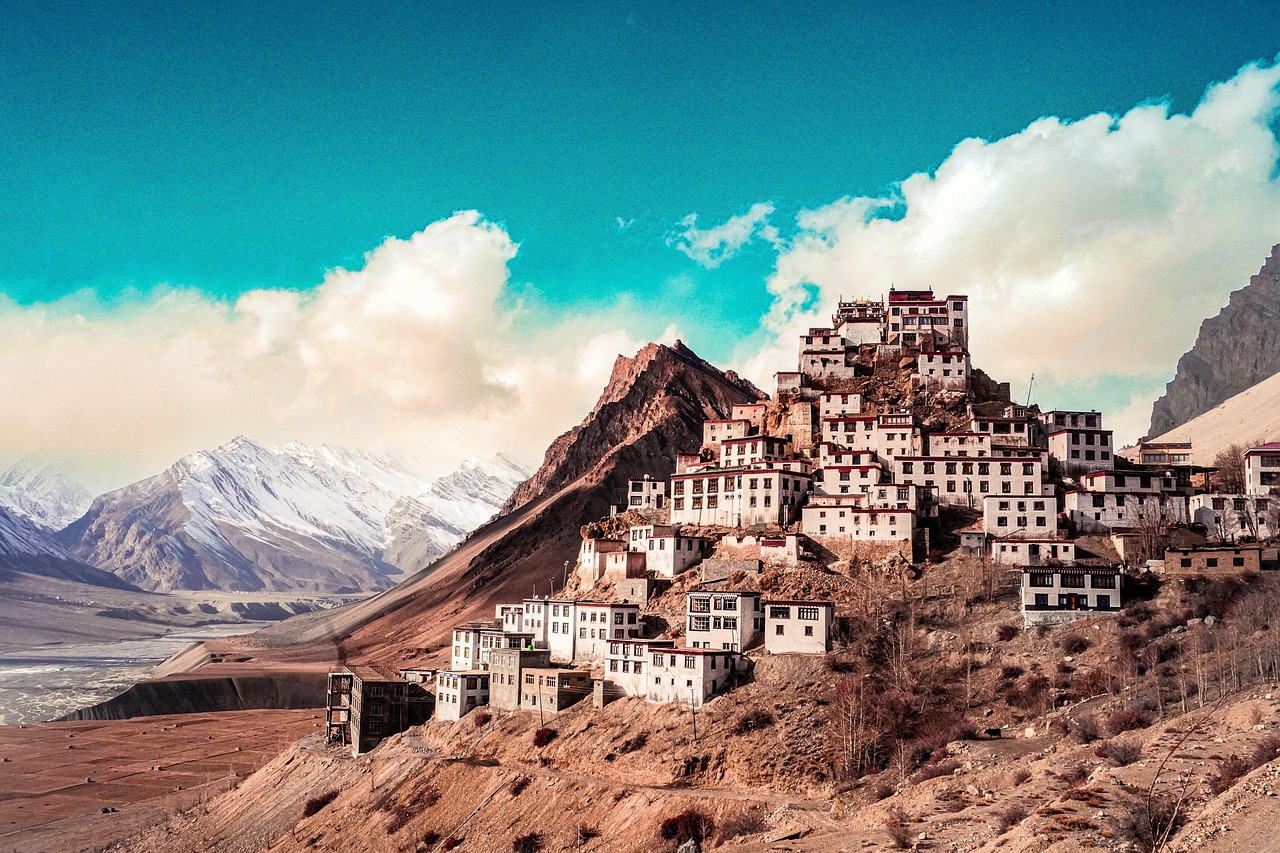
The United Nations Scientific Educational and Cultural Orgnization , UNESCo has included India’s Cold Desert Biosphere Reserve, in Jammu and Kashmir and Himachal Pradesh as one of the 26 new biosphere reserves across several countries.
It stretches from Ladakh (in the state of Jammu and Kashmir, or J&K) in the north to Kinnaur (in the state of Himachal Pradesh, or H.P.) in the south. The region constitutes a Cold Desert biome with harsh climatic conditions, which can be attributed to two factors.
One is its location on the leeward side of the Himalayas, which makes it a rain-shadow zone inaccessible to the annual south eastern monsoon winds that sweep the rest of the country, thus creating desert conditions with low levels of precipitation.
Second is its very high elevation (ranging from 3000 – 5000 metres above the sea level) adds to the coldness in its environment. There is a complete contrast in the climatic conditions, ranging from short and dry summers with harsh sunlight (maximum temperature reaching upto 36˚C during the day) to long, windy and freezing winters (minimum temperature touching -32˚C at night).
Blizzards, snowstorms and avalanches are common. The soil is not very fertile and the climatic conditions allow very short growing seasons making it a bare landscape. Water resources are minimal with glacier-fed streams.
This Cold Desert ecosystem has led to the development of a unique cultural system by small community living there unlike any other in the world. The settlements are small, isolated and sparsely populated but reflect how the inhabitants survive in these harsh conditions of the terrain and environment. The population belongs predominantly to the Indo-Mongoloid (Tibetan) race with some parts of western Ladakh occupied by the Dards, who are intermediaries of Ladakhis and Baltis of the neighbouring Baltistan in Pakistan occupied Kashmir (PoK).
The culture is a distinct variant of the Buddhist culture similar to the one of the Tibetan Autonomous Region. The people are simple folk used to hard labour with colourful customs, myths, beliefs and conventions that contrast with the barren and harsh environment and form the cultural highlight of this region.
Despite a common narrative, two distinct regions of human habitation and culture can be distinguished within this cold desert, namely the Leh-Kargil areas of Ladakh (J&K) and Spiti Valley. Although they have been closely linked throughout the ages politically and socially, the two regions have different histories attributable to their isolated geographic locations and separate access routes, from Indian as well as Tibetan sides.
While Ladakh lay on the trade routes from Punjab to Kashmir, and beyond to Baltistan (Skardo), Kashgar, Yarqand, Khotan (Eastern Central Asia or Xinjiang), Gartok, Lhasa (in Tibet) with Leh acting as an important trade centre, Spiti valley was more isolated and split into eastern and western valleys, connected with Ladakh & Tibet on eastern side & Kinnaur and Kulu on western side through high passes.
Ladakh (‘land of the passes’) is one of the most elevated (2,900 m to 5,900 m msl), and coldest regions (from -30°C to -70°C) of the earth. The region faces fast blowing winds 40-60 km/hr mainly in the afternoon hours. The soil moisture remains frozen during winters and with low relative humidity during the summer months. Despite such inhospitable conditions for survival, it is postulated that Ladakh has been occupied by humans since pre-historic times, as evidenced in the discovery of Lower Palaeolithic tools, Petroglyphs and other pre-historic art works that mark the beginning of man’s interaction with this cold desert landscape.
Evidence of its continued occupation can be ascertained throughout history since then, which is closely associated with Tibet. Spiti, locally pronounced as ‘Piti’, is known as the ‘middle country’ that lies between Tibet and India. Throughout history, it kept changing hands among the various kingdoms of Tibet, Ladakh, Kinnaur, Lahaul and Kullu. Subjugated to successive attacks and influences, many a times the rulers had to pay attributes to one another to keep peace in the region.
The archaeological records substantiate that the original inhabitants in these regions were also pastoral nomads who braved harsh climatic conditions of all sorts. For protection, they defied the natural forces and elements, and began to worship them. It is believed that this is how the Naga Cult (cult of snake worship) and others came into existence that revolve around the worship of natural features as tree, rivers, sun, moon et al.
The river Spiti originates at the base of the Kunzam range and flows eastward to join the Sutlej at Khab in Kinnaur. About 118 species of the Medicinal and Aromatic Plants are known from the valley. Various activities such as cultivation of medicinal plants, afforestation, ecotourism, land stabilization, etc. are carried out in these zones by the Central and State Government agencies to support the sustenance of its people.
Almost all settlements in the property are associated with Buddhist monasteries known as Gompas with a trademark prayer flag fluttering on top.Built either on flat land or atop the neighbouring hillock depending upon local factors, these shrines are the centers of the people’s cultural life and have influenced their religious beliefs for centuries.
Men usually fall back on the social security system of the Trans-Himalayan Gompas. The architecture of the region is an interesting amalgamation of Indian and Tibetan influences, and monastic buildings reflect a deeply Buddhist approach. Important Gompas in the J&K region include Hemis, Alchi Choskhor, Lamayaru, Likir, Thikse and Ridzon. Important Gompas in the H.P. region include Dhankar, Ki, Tabo, Mud, Gungri, Lidang, Hikim, Sagnam, Mane Gogma and Giu.
Each settlement and its Gompa have their own unique association and the predominant culture is intensely introverted. There are other architectural manifestations unique to this region. One is the Chorten (‘receptacle of worship’), which are remarkable types of stupas, and the Mani walls, long and thick platform-like row of stones, about 1 to 1.25 m high and 1.25 m wide, faced with carved stones inscribed with holy mantras.
The intangible cultural heritage of the property is also exceptional and diverse including agricultural and medicinal practices. The “Buddhist chanting of Ladakh: recitation of sacred Buddhist texts in the Trans-Himalayan Ladakh Region, Jammu and Kashmir, India”, has been inscribed since 2012 as one of elements on UNESCO’s Representative List of the Intangible Cultural Heritage of Humanity.
Buddhist lamas (priests) in monasteries and villages of Ladakh, Lahul-Spiti and Kinnaur chant sacred texts representing the spirit, philosophy and teachings of the Buddha. The performing arts (traditional dance including mask dance, theater, contemporary plays, folk music), craft-making techniques (thangkas, carpet weaving, pashmina and marino shawls and local quilt weaving, prayer flags of cloth, gold, silver, bronze sculptures, copper objects, wooden furniture including manuscript shelves, stone, stucco and clay), customs (sacred paintings, agriculture farming, kitchen-gardening, culinary, giving birth, wedding, death et al), rituals and beliefs (medicinal ritual called Am-chi), language and literature (heroic accomplishments, folk stories, legends, classical and vernacular language, dialects, songs, poems, ancient scripts), etc. are parts of cultural legacy and well-maintained intangible heritage traditions of the property.
Many rare and special varieties of flora and fauna are found here so much so that many national parks and wildlife reserves have been declared here by the Government for their protection. Furthermore, the Cold Desert has been declared as the 16th Biosphere Reserve of India in 2009 that includes Pin Valley National Park and surroundings, Chandratal and Sarchu, and the Kibber Wildlife Sanctuary in H.P. The Changtang Cold Desert Wildlife Sanctuary in district Leh, Jammu and Kashmir is another protected habitat for flora and fauna in the region. In Himachal Pradesh, among the floral elements, medicinal and aromatic plants such as Aconitum rotundifolium, Arnebiaeuchroma, Ephedra gerardiana, Ferula jaeschkeana, Hyoscymusniger are very well known, and one of the livelihood options for tribal communities.
Among the faunal elements, Woolly Hare, Tibetan Gazzle, Snow Leopard, Himalayan Black Bear, Himalayan Brown Bear, Snow Leopard, Red Fox, Tibetan Wolf, Himalayan Ibex, Himalayan Marmot, Himalayan Blue Sheep, Red Billed Chough, ChukarPatridge, Snow Patridge, Blue Rock Pigeon, Snow Pigeon, Himalayan Snowcock, Lammergeier, Himalayan Griffon, Golden Eagle, Rosefinches, et al are found in the area.
Presence of these unique cultural and biodiversity elements in the proposed landscape has high significance at regional, national and global levels. It is believed that people from the Steppes of Central Asia came to populate these areas between Khazakstan and China during Bronze Age (circa fourth millenium BCE). Remnants of prehistoric art further suggest that early immigrants to these regions were pastoralists who were attracted to the valleys and high mountains of the cold desert for summer transhumance. It is also a popular belief that Buddhism was first introduced to Ladakh about 200 BCE during the reign of Maurya Emperor, Asoka the Great.
The first Buddhist temple in Ladakh is believed to have been constructed in the Suru valley near Kargil. The Kanika stupa at Sani in Zanskar is another famous stupa which some believe to have been constructed by the Kushan ruler, Kanishka, in second century CE.
Ladakh is also mentioned by the Chinese travelers Fa-Hein (405-411) and Hiuen Tsang (630-645 CE), who passed through this area and referred to it as Kia-Chha and Ma-Lo-Pho respectively. In the eight century CE, during the reign of Tibetan king, Khri-strong-Ide-btsan, the famous Indian scholar, Padmasambhava, also known as U-rgyan-Rinpoche, visited Baltistan and Ladakh. It was Padmasambhava who together with the great BhikhuShantaRakshita (Mkhan-chen-zhi-was-‘tsho) firmly established Buddhism in Ladakh and Tibet.
The kings of the First Royal Dynasty of Ladakh kingdom are stated to have ruled the Western Tibet and Ladakh region from around the first millennium CE. Special paintings called thankas (paintings on cloth) displayed Jataka stories and other Buddhist themes as part of the Ladakhi culture.
An exceptional thanka, (paintings on cloth) believed to be the biggest in the world, having an image of Padmasmbhava in his eight principle forms, and embroider with pearls, is ritually exhibited once in twelve year in the year of “Monkey”, according to the Buddhist Calendar, in Hemis monastery.
Rooted in Buddhism, the culture of the region is strongly affiliated with Tibet but traces of Indian influences make it unique and one of its kind, which is also manifest in its architecture and intangible traditions that are already world renowned. The Cold Desert region has a living culture of its own which is an amalgamation of Indian and Tibetan influences, is reflective in the form of Buddhism practiced here and further manifest in its art, architecture, lifestyle, food, clothing, dance, music et al.
It houses endangered species like the Snow Leopard, Tibetan Antelope and Himalayan Wolf, which are included in the Red List of IUCN as Critically Endangered Species. The variety of flora found here has been used traditionally for various purposes by the community including medicinal, and is deemed to be of Outstanding Universal Value for the purposes of conservation.