
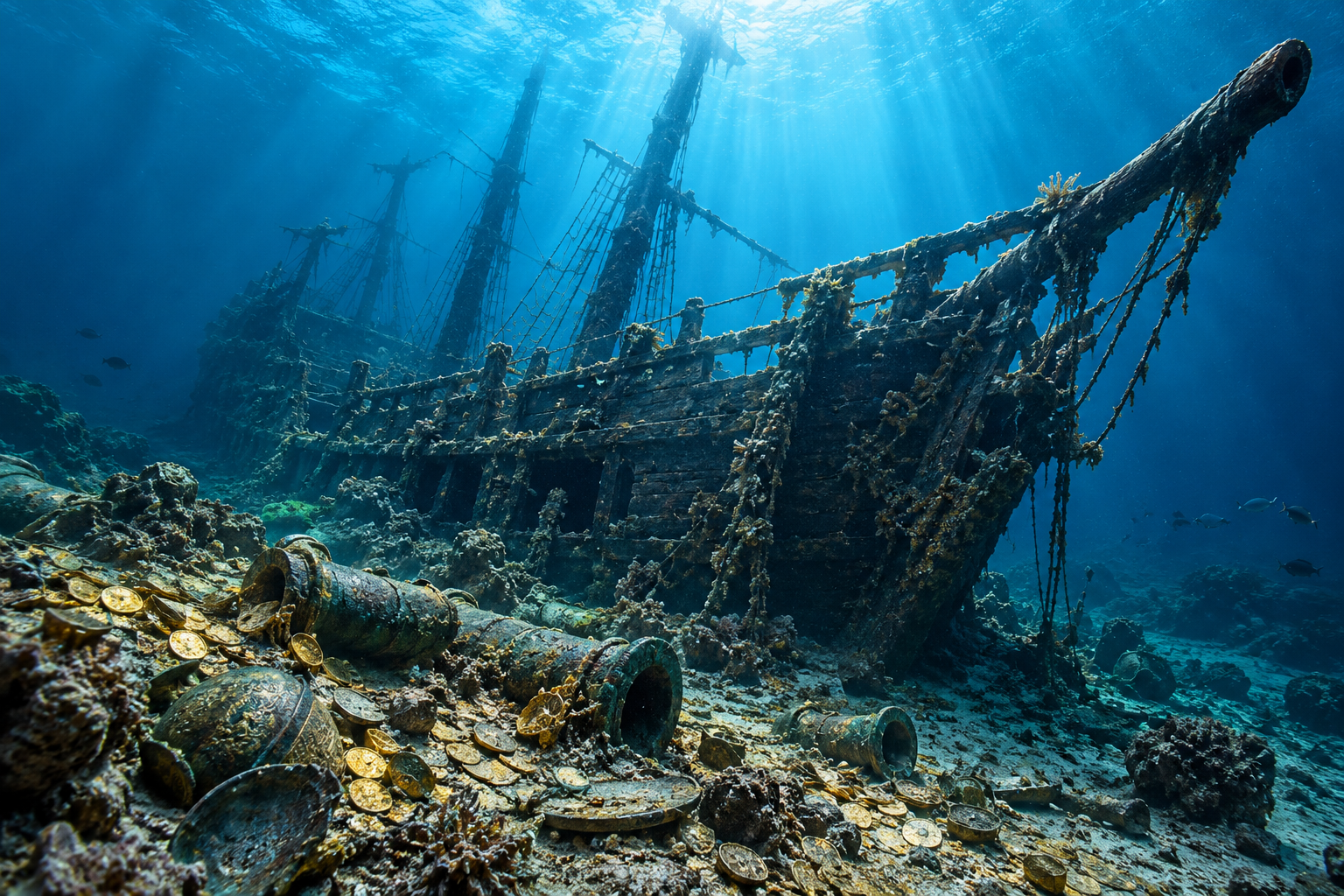
Who is the rightful owner of a shipwreck in the sea ? The owner to whom the ship belonged ? The country near which the ship sank in the sea, or those who actually located the wreck? These are not just academic questions. The correct answer may make the rightful owner win or lose a sunken treasure worth US $ 20 billion.
This matter of the world’s greatest sunken treasure off Colombia in a Spanish ship is at present with the Permanent Court of Arbitration of the United Nations, in The Hague. The Spanish ship San Jose belonging to 18th century Spain, sank off the coast of Cartagena in the sea shores of Colombia, south America in 1708 following an attack by a royal British navy ship. An US company Sea Search Armada with permission from Colombia some years back was able to locate it in the sea.
The Sea Search Armada had gone ahead for the search to locate the ship on the promise of a 50:50 share. But after they were successful in locating the ship with $ 20 billion worth of treasure, Clombian government seemed to get cold feet regarding parting with a share of the treasure. According to agreement Sea Search Armada is claiming $ 10 billion of the estimated $ 20 billion Spanish treasure.
The matter went to the Colombian Supreme Court which ordered in favour of the company urging the Colombian government to comply with their part of the agreement and share the treasure with the company which had located the ship. Still reluctant Colombia cleverly passed a law classifying the wreck as a non-commercial property and redefined the wreck as “cultural heritage.” The government had realised its historical and archaeological value which made the wreck virtually priceless, being part of the country’s historical past. Colombian government has initiated expeditions for research and study of the wreck.
With the Columbian government not ready to part with $10 billion, the Sea Search Armada has gone for international arbitration to get its $ 10 billion from the Columbian government.
Interestingly, Colombian President Gustavo Petro aims to recover the $20 billion treasure of San Jose shipwreck before his term ends in 2026. The Sea Search Armada (SSA) is saying that Colombia has gone against the U.S.-Colombia Trade Promotion Agreement, bypassing a 50/50 share agreement.
Interestingly Cuban American archaeologist Roger Dooley also claims he had found from Byzantine Spanish archives, hidden documents that contained clues of the legendary galleon San José, which sank in battle with a British squadron off Colombia in 1708, along with 600 men and a cargo of gold and silver estimated to be worth billions of dollars. It has been called the Holy Grail of Shipwrecks.
In 2015, Roger Dooley, and his colleagues found a sword hilt sticking out of the sand, and three bronze cannons in a bed of seashells — each bearing a small dolphin-shaped marking identifying it as part of San José, a Spanish galleon with a cargo estimated to now be worth US $ 20 billion or more.
The Court of Permanent Arbitration in The Hague is expected to rule this year on competing claims.
Dooley’s claims are also being backed by a British company called Maritime Archaeology Consultants (MAC) formed by hedge-fund titan Anthony Clarke. Dooley’s backers, signed an agreement with the Colombian government under then-president Juan Manuel Santos entitling them to up to 45% of any recoverable treasure, claiming to be original finders.
San José had been the flagship of Spain’s treasure fleet, carrying gold, silver, and emeralds extracted from across the Americas. On the evening of June 8, 1708, British commodore Charles Wager attacked the fleet off the coast of Cartagena. A fire broke out aboard the San José, and the ship reportedly “blew up,”.
In 2013, Maritime Archaeology Consultants backed Dooley as he narrowed the search to a 43-square-mile patch of seabed off Colombia. Woods Hole Oceanographic Institution deployed its REMUS autonomous underwater vehicle, a $ 3 million yellow torpedo that can dive to 6,000 meters and scan the seafloor with sonar while swimming autonomously for up to 24 hours.
Spain has also jumped in claiming ownership over its lost naval vessels worldwide, invoking sovereign immunity. It’s described the San José as a mass grave that should remain untouched. Colombia insists the wreck lies within or just beyond its territorial waters, at the edge of its twelve-mile limit, and in any case within its exclusive economic zone and thus the wreck belongs to it. The country has recovered a handful of less valuable items, such as coins and cannons, from the wreck.
The original indigenous communities in Bolivia have also put in their stake by stating that it is the Bolivion forced labour which had mined most of the silver and gold that the Spanish conquerors had taken from them. They have objected to Colombia’s plans to recover the remains of an 18th-century galleon calling on Spain and Unesco to step in and halt the project.
Colombia hopes to begin recovering artefacts from the wreck of the San José in the coming months but the Caranga, Chicha and Killaka peoples in Bolivia propose that the galleon and its contents should be considered “common and shared patrimony”.
The Colombian government hopes to build a museum dedicated to the 150ft (46-metre) San Jose.
The Bolivian communities have requested that Spain and Unesco intervene before Colombia can begin unilaterally lifting the remains of the wreck from the seabed. Bolivian communities hope to be paid “fair compensation for the use of our cultural legacy” even if they were used in a Colombian museum.
Several indigenous groups like the Qhara Qhara, the Caranga, Chicha and Killaka are all laying claim to San José’s treasure.The treasure remains on the ocean floor until an international court makes a decision.
Interestingly, while Sea Search Armada (SSA) claimed to have located the wreck in 1980 and wanted 50 per cent share which the Colombian Supreme Court ruled should be given to the company if any treasure was found at or near the coordinates they reported. It is being disputed by some that there is no trace of a ship at those coordinates, and that whatever SSA discovered was certainly not the San José.
The shipwreck is believed to contain about 11 million gold and silver coins, along with emeralds and other valuable cargo.
The site has remained untouched for over 300 years until the recent carefully controlled extraction.
According to Colombian authorities, remotely operated vehicles (ROVs) were used to retrieve selected objects from the upper layers of the debris field, at depths approaching 600 metres. The recovery marks the first stage of a multi-year scientific programme designed to document and preserve the wreck, rather than pursue commercial salvage.
Colombian authorities announced that a cannon, three coins, and a porcelain cup have been brought to the surface. “Allowing the commercial exploitation of Colombia’s cultural heritage goes against the best scientific standards and international ethical principles as laid down especially in the UNESCO Underwater Cultural Heritage Convention,” says the UNESCO. Colombia has not signed the UN Convention on the Law of the Sea, which would subject it to international standards and require it to inform UNESCO of its plans for the wreck.
The wreck was discovered few years ago with the help of an international team of experts and autonomous underwater vehicles, and its exact location is a Colombian state secret.