
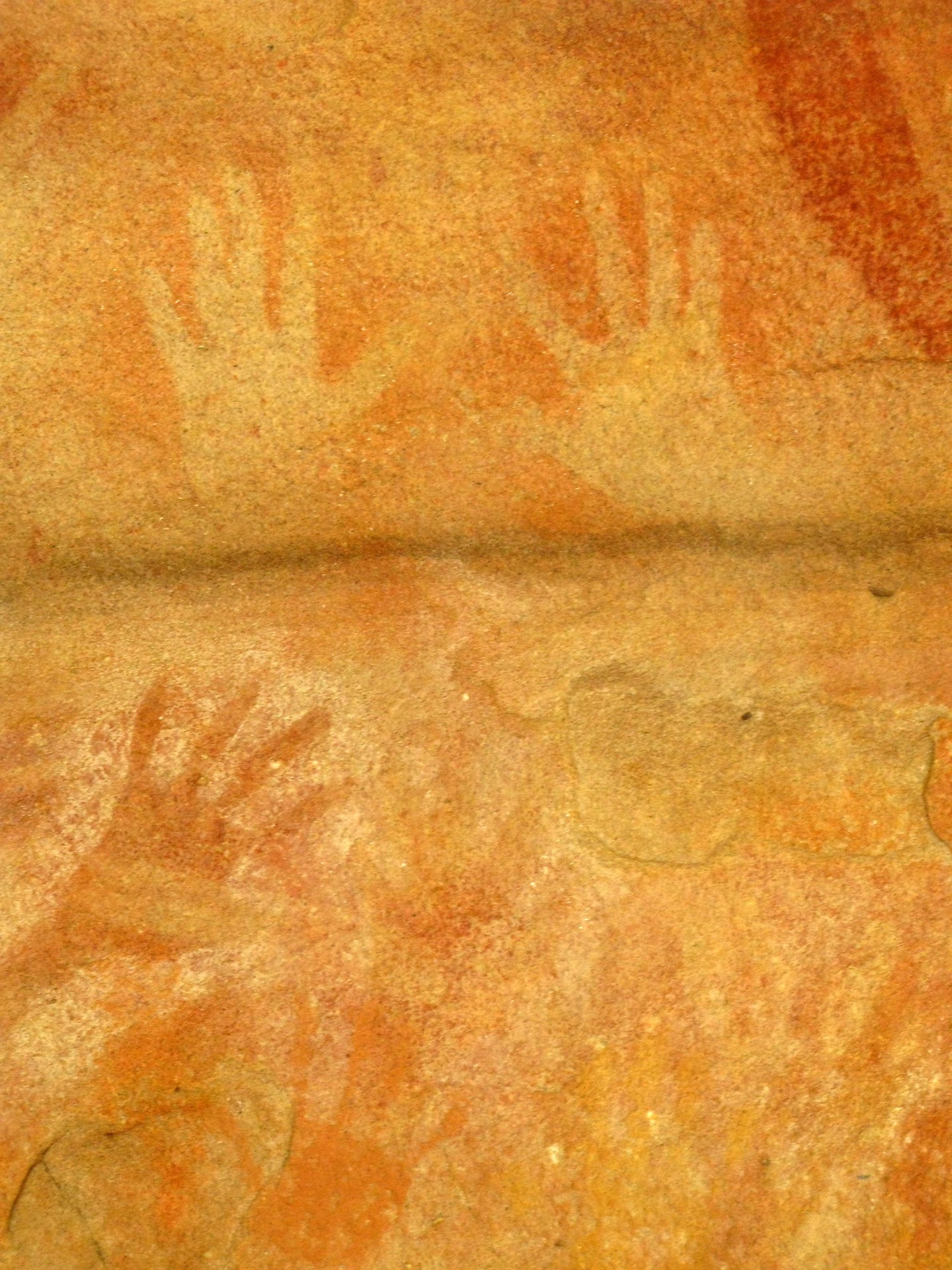
A faded hand stencil discovered in a limestone cave in Indonesia has been dated to at least 67,800 years ago, making it the oldest securely dated cave art attributed to our species yet discovered and offering remarkable new evidence of the antiquity of human creativity and symbolic thought.
The ancient hand stencil was found at Liang Metanduno cave on Muna Island, off southeastern Sulawesi. Researchers believe it was created by placing a hand against the cave wall and applying pigment around it, leaving behind a negative impression.
What makes the image particularly intriguing is the appearance of its fingers. At least one fingertip appears to have been deliberately narrowed, either by adding pigment or manipulating the hand during the creation of the stencil.
The effect gives the finger a pointed or claw-like appearance, suggesting that its creator was doing more than simply leaving a representation of a human hand.
The discovery pushes the securely established history of cave art attributed to Homo sapiens much further into the past.
Researchers used advanced laser-ablation uranium-series dating to analyse microscopic calcium carbonate deposits that had formed over the image. Because the mineral deposits developed after the artwork was created, they establish a minimum age for the stencil.
The results indicate that the hand stencil is at least 67,800 years old.
That makes it more than 16,000 years older than the previous minimum-age record for rock art from the Maros-Pangkep region of Sulawesi.
The discovery is significant not merely because of its extraordinary age. It also challenges the traditional Eurocentric picture of prehistoric art in which the celebrated painted caves of France and Spain occupied centre stage in accounts of early human artistic development.
Some of Europe’s most famous cave paintings remain extraordinary achievements of prehistoric culture, but discoveries in Indonesia and elsewhere increasingly demonstrate that sophisticated artistic and symbolic behaviour was geographically widespread.
The Indonesian discovery therefore raises a much bigger question: why did ancient humans make art in the first place?
Every discovery of prehistoric rock art focuses attention on the revolutionary role of symbolic thought in the development of human civilisation.
One of the characteristics that has allowed human culture to develop to extraordinary levels of complexity is our capacity to create, understand and transmit meaning through symbols.
Language itself depends upon this ability.
The letters R, E and D, for example, are simply visual symbols. Put together in a particular order, however, they convey the concept of the colour red to anyone who understands English.
The written word is not the colour itself. It is a symbolic representation of it.
Much of human civilisation operates through this same process. Alphabets, numbers, maps, religious symbols, mathematical equations, musical notation, flags and computer code all depend upon our ability to allow one thing to stand for another.
Human beings, in that sense, inhabit an intensely symbolic world.
Almost everything we experience, think about or communicate can be represented through words, images, sounds or other symbols.
The ancient hand stencil on Muna Island may therefore represent far more than an individual placing a hand against a cave wall tens of thousands of years ago.
Its deliberate creation suggests that its maker understood that an image could carry meaning beyond the immediate physical act of making it.
That is one reason prehistoric art is so important to understanding the development of the human mind.
An image created tens of thousands of years ago can still be seen by another human today. Although we may never know precisely what its creator intended, we can recognise the hand, understand that the image was deliberately produced and attempt to interpret its meaning.
In this way, art allows information and ideas to travel across both space and time.
Rock art predates written language by tens of thousands of years, but it provides evidence of the ability of ancient humans to use visual representation.
Dots, lines, geometric patterns, hand stencils and representations of animals may have served different purposes — from ritual and storytelling to identity, communication or simple artistic expression.
It would be risky to describe such images as a written language without evidence that they encoded language in a systematic way. But they unquestionably demonstrate capacities closely associated with symbolic communication.
The archaeological record suggests these abilities have very deep roots.
Geometric engravings on ochre from Blombos Cave in southern Africa, for example, date back tens of thousands of years and provide another striking example of early symbolic behaviour.
There is also evidence that Neanderthals were capable of symbolic behaviour. Some ancient markings and cave art in Europe have been attributed to Neanderthals, although the dating and interpretation of certain examples remain debated.
The Indonesian hand stencil adds another extraordinary piece to this complex story.
Researchers attribute the Muna Island artwork to Homo sapiens, partly because of the technically and stylistically modified fingers and because its age is broadly consistent with evidence for the arrival of modern humans in the region.
However, the researchers also acknowledge that it is impossible to identify the individual or human population that physically made the stencil with absolute certainty.
The location of the discovery is particularly significant.
Sulawesi lies in Wallacea, the island zone between continental Southeast Asia and the ancient landmass of Sahul, which incorporated Australia and New Guinea.
The presence of humans capable of creating sophisticated rock art in Sulawesi at least 67,800 years ago adds evidence to the story of early human movement through this island world.
Those populations would have needed to make sea crossings as they moved through the region towards Sahul.
The discovery therefore tells us something not only about prehistoric art but also about the extraordinary abilities of early humans to travel, adapt and transmit culture.
The Liang Metanduno cave appears to have remained a place of artistic activity for an exceptionally long period.
Researchers found evidence of multiple episodes of art production separated by tens of thousands of years, while much younger paintings were subsequently created in the cave.
That extraordinary span suggests that the cave landscape remained culturally meaningful to different generations and possibly entirely different societies over vast stretches of human history.
For generations, the famous painted caves of Europe shaped popular ideas about the origins of art.
Discoveries across Indonesia, Africa, Australia and other parts of the world are now producing a far richer picture.
Art did not suddenly emerge in one European cultural centre and spread outward. The accumulating archaeological evidence points instead towards a much deeper and geographically diverse history of human symbolic expression.
“Cave art” is consequently not merely about pictures on stone.
It opens a window into the evolution of the human mind.
The capacity to turn a hand into an image, an animal into a painted form or an idea into a symbol ultimately belongs to the same remarkable human ability that would later make possible writing, literature, mathematics, religion, science and the enormous networks of communication upon which civilisation depends.
A hand pressed against a cave wall on an Indonesian island at least 67,800 years ago may appear simple compared with the elaborate visual culture of the modern world.
Yet behind that apparently simple image lies something profoundly human: the ability to transform an object, thought or experience into a symbol that another person can recognise.
Tens of thousands of years later, we are still looking at that hand.
And, even if its precise message has been lost, we still recognise it as an attempt by another human being to leave an image behind.