
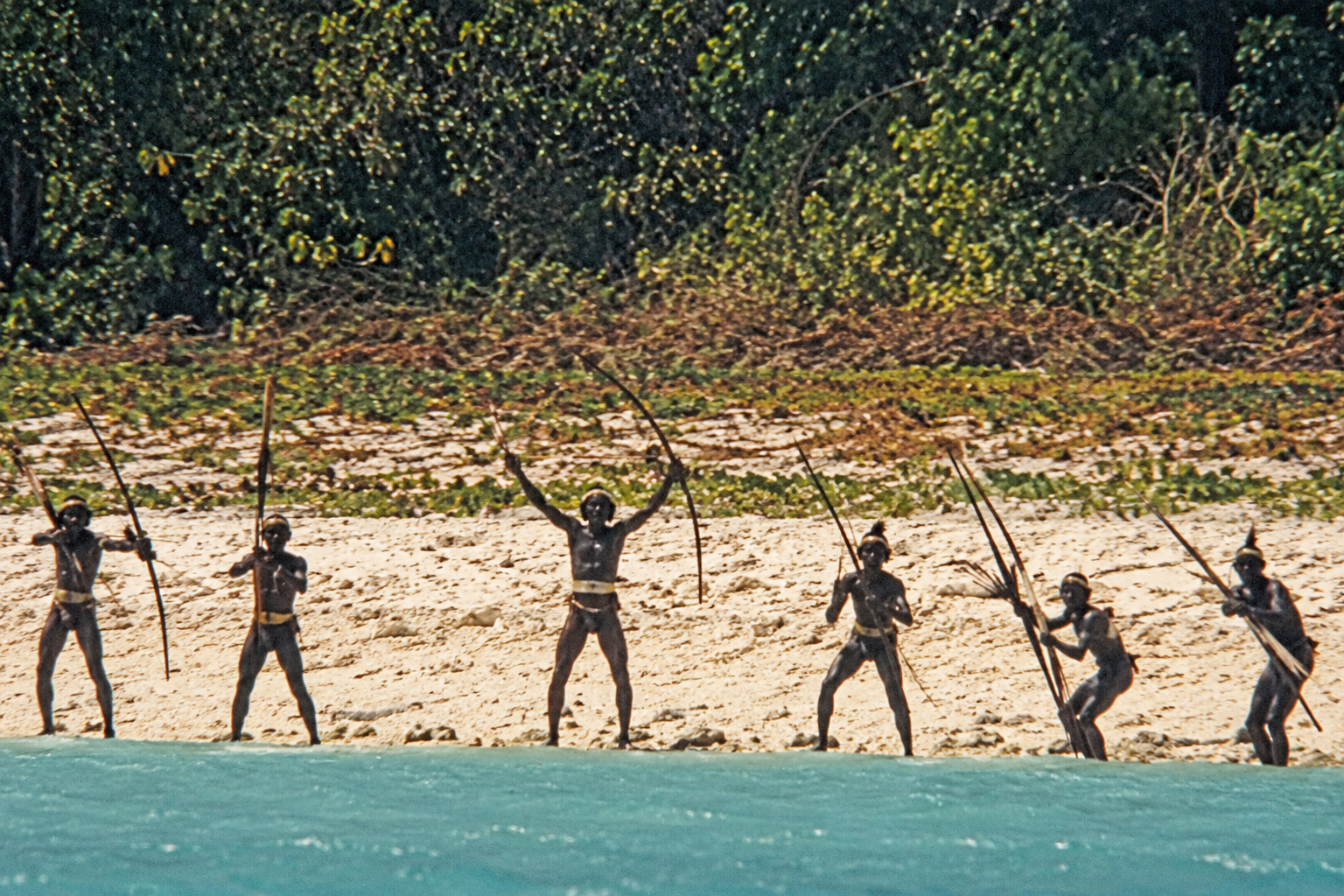
The Sentinelese of North Sentinel Island are famous for resisting contact with the outside world.
Their hostility towards intruders is often portrayed as mysterious. But the history of outside attempts to contact them provides considerable reason for caution.
One of the earliest documented colonial encounters took place in 1880, when British naval officer Maurice Vidal Portman landed on North Sentinel Island with a large party.
The expedition initially found abandoned settlements rather than inhabitants.
Eventually, an elderly couple and four children were captured and taken to Port Blair, the colonial headquarters in the Andaman Islands.
The captives became ill. The elderly couple died, while the children were eventually returned to North Sentinel Island with gifts.
Whatever the Sentinelese understood about what had happened, the encounter demonstrated the potentially devastating consequences of exposing an isolated population to outsiders and their diseases.
Another violent episode occurred in 1896.
An escaped convict from the penal colony on Great Andaman reportedly reached North Sentinel Island on a makeshift raft. A colonial search party subsequently discovered his body with arrow wounds and his throat cut.
For much of the following period, there was relatively little interference with the islanders.
But attempts at contact increased again during the 20th century.
In 1974, a film crew accompanying an expedition to the island encountered armed resistance, and a director was reportedly struck in the thigh by an arrow.
During some government expeditions, gifts were left for the Sentinelese in an attempt to establish friendly relations.
Not all were welcomed.
On one expedition, a pig and a doll were reportedly left on the beach. The Sentinelese speared and buried the pig and also buried the doll.
Then something remarkable happened in 1991.
For perhaps the first time in documented history, Sentinelese islanders voluntarily approached outsiders without immediately displaying the same level of hostility.
Indian anthropologist Madhumala Chattopadhyay was part of a 13-member expedition that approached North Sentinel Island on January 4, 1991.
As the boat neared the island, members of the team saw Sentinelese carrying bows and arrows.
The visitors began dropping coconuts into the water.
Several Sentinelese approached in canoes and collected them.
During another encounter, the islanders came close enough to take coconuts directly.
There was still danger.
At one point, a young Sentinelese man reportedly aimed an arrow towards the visitors before a Sentinelese woman intervened.
Chattopadhyay eventually entered the water and personally handed coconuts to members of the community.
It became one of the most remarkable episodes in the history of attempts to establish peaceful contact with the Sentinelese.
Other members of Indian contact teams experienced similarly extraordinary moments.
Anthropologist T.N. Pandit, who participated in several expeditions, recalled interactions in which the Sentinelese communicated through gestures when they wanted outsiders to leave.
For a brief period, it appeared that relations might be changing.
Government gift-dropping expeditions continued for several years.
But the encounters remained unpredictable and dangerous. At times, Sentinelese aimed arrows at the visitors and attacked boats.
By 1996, regular contact expeditions were stopped.
The decision represented an important change in thinking: rather than trying to integrate the Sentinelese into wider society, the priority increasingly became protecting their right to remain isolated.
Their determination to remain undisturbed became dramatically visible following the 2004 Indian Ocean tsunami.
There was concern that the enormous waves might have devastated North Sentinel Island.
When an Indian Coast Guard helicopter flew over the island to check on the population, a Sentinelese man emerged on the beach and fired arrows at it.
The image became famous around the world.
The message appeared unmistakable: they had survived, and outsiders were still not welcome.
In 2006, two Indian fishermen were killed after their boat drifted close to the island.
Then, in 2018, the Sentinelese attracted worldwide attention following the death of American missionary John Allen Chau.
Chau wanted to make contact with the community and preach Christianity.
Despite restrictions prohibiting outsiders from approaching the island, he reportedly arranged for local fishermen to take him close to North Sentinel before continuing towards shore.
His attempts ended in his death.
Fishermen subsequently reported seeing islanders dragging and burying his body on the beach.
The incident generated an international debate about missionary activity, the rights of isolated Indigenous peoples and whether outsiders have any right to make contact with a community that has repeatedly rejected it.
The Sentinelese have sometimes been described simply as hostile.
Their history suggests a more complicated picture.
There have been moments of peaceful interaction, particularly during the extraordinary encounters of 1991. But there have also been repeated invasions of their territory, attempts to remove members of their community, unwanted expeditions and potentially deadly exposure to outside diseases.
Neighbouring Indigenous peoples of the Andaman Islands suffered devastating population losses following sustained outside contact.
That history helps explain why India’s policy towards North Sentinel Island has increasingly favoured isolation rather than forced contact.
The Sentinelese have survived for generations without integration into the modern world.
Perhaps the most important lesson from more than a century of encounters is that contact does not necessarily mean progress.
Sometimes, leaving people alone may be the greatest protection outsiders can offer.
One Comment
Comments are closed.