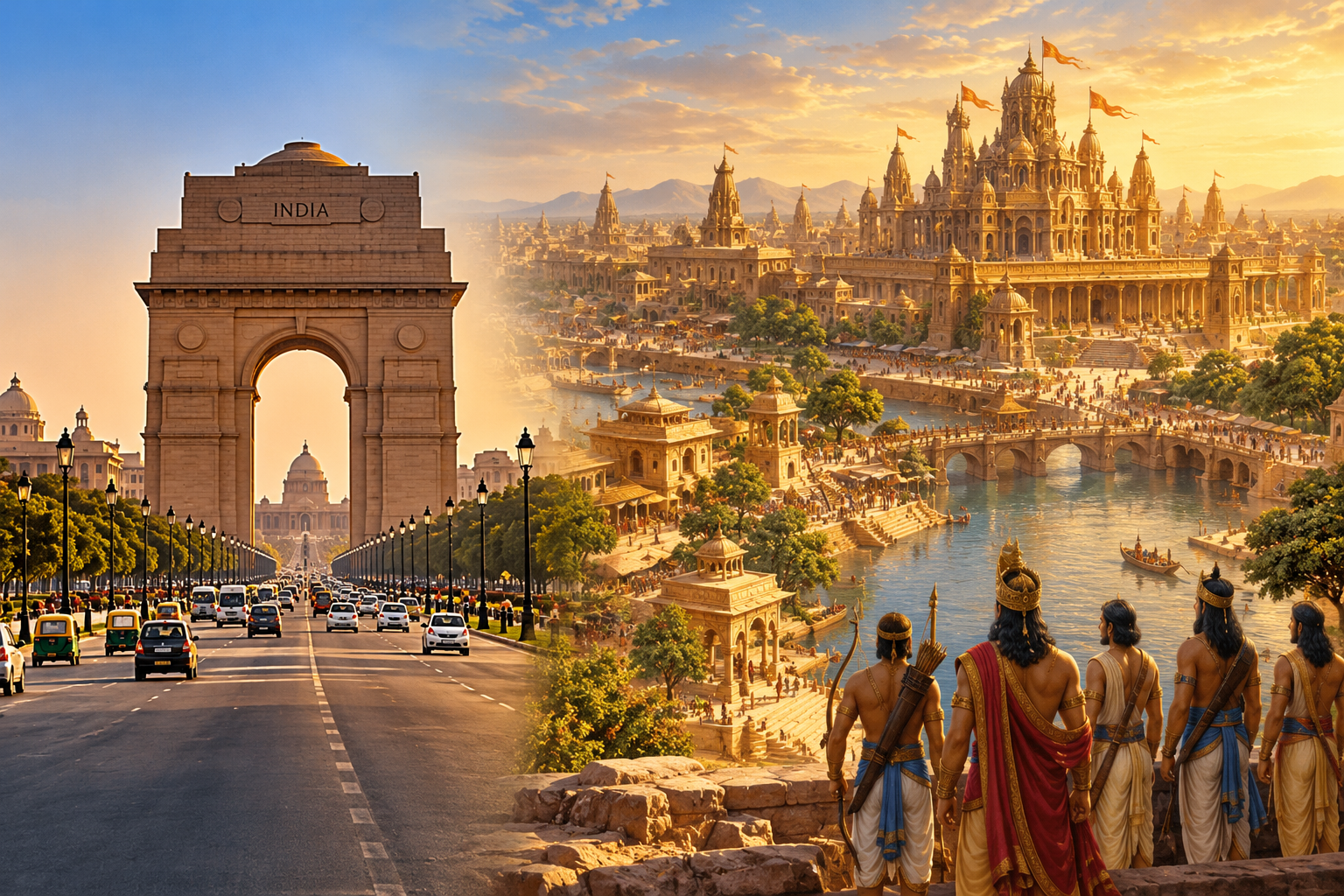
The latest demand which has again come from a BJP Member of Parliament is likely to create serious debate on the whole issue of naming public spaces whether it be a road or a city.
The Chandni Chowk MP Mr Khandelwal of the Bharatiya Janata Party has urged the central government in a letter written to the Union Home Minister Amit Shah to rename Delhi as Indraprastha.
He has just reiterated a demand which he has made earlier too.
Clearly to change the name of the capital city is a unlike changing the name of a road or a city or town in India.
Internationally renowned and a name which has continued for years for India’s capital witnessing political ups and downs throughout many centuries cannot be changed without wide consultations.
Firstly, why Indraprastha? No doubt the name of the famous capital of the Pandavas, the heroes of the well known Hindu epic Mahabharata , will attach grandeur and heritage to the name of the capital.
For the Bharatiya Janata Party, the pro-Hindu rightist ruling party of India , changing the name of Delhi will definitely add a feather to its cap thrilling its (Hindu) vote bank and re-establishing the fact that the party would leave no stone upturned to remove all the vestiges of foreign rulers and restore the past glory of Hindu rulers. But the move may be opposed by scholars, opposition parties and secularists as an attempt to give the name of the capital city of a secular country a name with blatant Hindu connotations.
To revive the Hindu heritage of the city Mr Khandelwal in the letter has also suggested that statues of the Pandavas should be installed at a suitable location in Delhi, possibly at Purana Qila, to revive the city’s ancient cultural identity.
In a separate letter to Delhi Chief Minister Rekha Gupta, he requested that the Delhi Assembly pass a resolution supporting the renaming of Delhi to Indraprastha.
During the Tomar period before the Muslim invaders took over from the 8th century to 12th century Delhi was known as Dhillika or Dhillikapuri as a fortified city established by Ananangpal Tomar, the Rajput, Hindu King.
This has a very interesting history, the 7-metre iron pillar at Qutub Minar supposedly 1,600 years old from the Gupta period, was first erected somewhere in central India and in the 11th century, King Anangpal Tomar II brought the pillar to Mehrauli and installed it in his fortified city. People believed the pillar acted like a “nail” holding the earth steady. When Anangpal tried to move it, it became loose (dheela) and the word Dhillika or Dhilli was used for the name of the city founded by Anangpal Tomar II.
As Delhi from the 12th century to 16th century has primarily been the seat of Muslim rulers like the Mamluk,Khilji,Tughlaq,Sayyid ,Lodi and Mughal dynasties. It is then that the name actually changed to doorstep or Dehleez during the Persian rule, as it was the doorway into India. During Mughal times too the name of the Delhi continued to be Dehli.
When the British took over India and the capital of British India was shifted from Calcutta to Delhi, they preferred to keep the name of the city as Delhi.
As far as the name Indra Prastha was concerned Abdul Fazil writes in the Ain-I-Akbari (chronicling the rule of Mughal emperor Akbar) in the sixteenth century that during the reign of Akbar, Indraprastha, the capital of the Pandavas, was located at the spot where Humayun built his fort, the Purana Qila.
Till the end of the nineteenth century, there was a village called Indarpat inside that fort.
Whether the site was actually Indraprastha or not was never established because whether Mahabharata itself is based on fact or the epic is entirely a mythology is not clear as yet.
Archaeologists carried out excavations at the Purana Qila from the 1950’s to the 1970’s. they wanted to find out how old this site was, and to find out whether or not it could be identified with ancient Indraprastha.
The excavations showed that the Purana Qila was indeed a very old site. Archaeologists found that the settlement had many phases dating from about the fourth century B.C. (or earlier) to the nineteenth century A.D. Pieces of old pottery known as Painted Grey Ware (PGW for short) were also found here and there, and this suggested that people may have lived at some spot in or around the Purana Qila from about 1000 B.C. onwards.
The Purana Qila was built by the Mughal Emperor Humayun.
Some archaeologists say the PGW pottery suggests links of the site to the ancient city Indraprastha. They say that 1100 BCE and 500/400 BCE is the timeframe that matches some of the wide estimates of when the Mahabharata was composed.
ASI’s findings, in each of the other Mahabharata-related sites excavated by archaeologist B.B. Lal, such as Hastinapur, Tilpat and Kurukshetra, the PGW formed the lowest cultural deposit. So its presence at Purana Qila suggests its Mahabharata link.
It was well established by B B Lal that PGW is associated with the Mahabharata period.
Indraprastha is mentioned in ancient Indian literature as a city of the Kuru Kingdom.
During the Mauryan period, Indraprastha was known as Indapatta in Buddhist Pali literature, as the capital of the Kuru Mahajanapada. The Kuru kingdom appeared in the Middle Vedic period (1200 BCE), encompassing parts of the modern-day states of Haryana, Delhi, and some parts of western Uttar Pradesh.It declined in importance during the late Vedic period (900-500 BCE).
Indraprastha means the city of the Hindu god Indra. So even during the Mahabharata time they wanted to keep their capital’s name on the city of a prominent Hindu god.
Renaming Delhi is not going to be easy as the metropolitan city being the capital of India houses people from all over India and there is likely to be opposition by some group or another.
However this may be the opportune moment for the BJP as it rules both Delhi and the Centre.
The important administrative step would be for the state government to pass a Bill for renaming the state by voting and then if passed send the proposal to the Union government to clear it . The Ministry of Home Affairs must then approve the new nomenclature and send in its “no objection” — before issuing a notice in the Gazette of India.
Then the new name of the location will become official.
The renaming of Calcutta to Kolkatta and Madras to Chennai were done also to reinforce our regional pride. However the proposal to change the name of Ahmedabad in Gujarat in 1988 was rejected by the Union government due to fears of its effect internationally as a it is a major business hub.
Port Blair in the Andaman and Nicobar Islands has become Sri Vijaya Puram, Bengalore has been changed To Bangaluru, Aurangabad to Chhatrapati Sambhajinagar, the second ruler of the Maratha Empire, Allahad has been changed to Prayagraj.
MP Praveen Khandelwal believes renaming Delhi to Indraprastha would restore the city’s ancient identity, boost national pride, and showcase India’s rich cultural heritage
Only recently central government approved the renaming of Kerala as ‘Keralam’.
MP Praveen Khandelwal has argued that Indraprastha, a name rooted in the Mahabharata, represents the city’s earliest civilisational identity.
He believes that restoring this ancient name would highlight India’s cultural heritage and strengthen national pride. The name change, he says, would symbolise that the world’s largest democracy is built upon a foundation of timeless cultural traditions.
He urged the Ministry of Home Affairs to consult with historians, archaeologists, and other stakeholders before taking a decision on the proposal.
Praveen Khandelwal has said India is one of the oldest living civilisations in the world, and the name of its capital should reflect its ancient cultural roots.
He said historical texts and archaeological findings suggest that present-day Delhi was once Indraprastha, the capital established by the Pandavas as described in the Mahabharata.
He said several Indian cities have restored their historical names in recent years and added that renaming Delhi would be a step towards reconnecting the capital with India’s ancient heritage.
According to the Mahabharata, the legendary city of Indraprastha was founded by the five Pandava brothers for their queen, Draupadi. Its wide streets and orchards surrounded a palatial hall, built by the demon-architect Maya.
The hall was ‘so rich and well built’ that it rivalled the celestial home of Brahma. Its columns and arches were inlaid with jewels, and its golden walls were ‘adorned with many varied pictures’. It also contained many artful illusions: a crystal floor that looked like a lotus pond, set with flowers cut from gemstones; and a real pool so clear and still it appeared to be solid stone. There were doors that looked like walls, and walls that looked like doorways.
The idea of naming it Indraprastha is clearly to move away from a name associate more with a city built by sultans and emperors in the Islamic period. The clty is dotted with mosques ,forts and tombs of the Islamic period. This does not go easy with the Hindu nationalists even though the Islamic rule ended hundreds of years ago.
The Bharatiya Janata Party (BJP) would rather its capital be called “Indraprastha” rather than Delhi which reminds of a time when the country was under Islamic and British rule.

Views | News | Opinions
Views | News | Opinions