
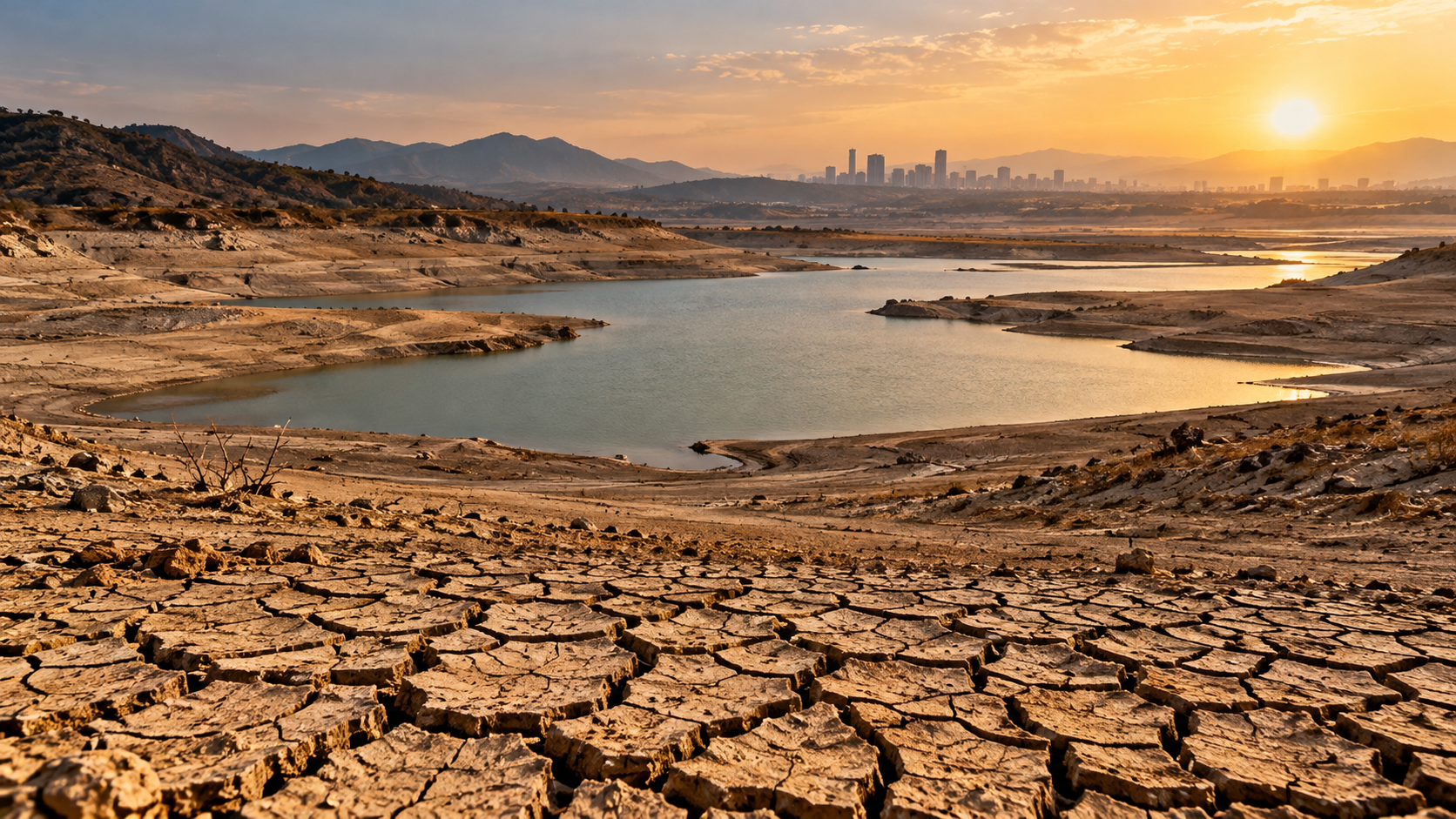
In a chilling reminder of the state of the world’s water resources, the United Nations University Institute for Water, Environment and Health (UNU-INWEH) has declared the “dawn of an era of global water bankruptcy”.
Nearly three-quarters of the world’s population lives in countries classified as water-insecure or critically water-insecure, while about four billion people experience severe water scarcity for at least one month every year.
The warning comes in the report Global Water Bankruptcy: Living Beyond Our Hydrological Means in the Post-Crisis Era, released ahead of preparations for the 2026 UN Water Conference, to be co-hosted by the United Arab Emirates and Senegal.
The report argues that global heating, chronic groundwater depletion, excessive allocation of water resources, land and soil degradation, deforestation and pollution have combined to create conditions far more serious than those traditionally described as “water stress” or a “water crisis”.
Instead, the world is increasingly facing what the report describes as a post-crisis condition marked by irreversible losses of natural water capital and an inability in many water systems to return to historic baselines.
Yet Professor Kaveh Madani, Director of UNU-INWEH — often described as the UN’s think tank on water — stresses that the warning should not be interpreted as a declaration of hopelessness.
“Despite its warnings, the report is not a statement of hopelessness,” Madani said. “It is a call for honesty, realism, and transformation.”
He argues that acknowledging water bankruptcy could force governments and societies to make difficult choices necessary to protect people, economies and ecosystems before the global water deficit becomes even more severe.
“Bankruptcy management requires honesty, courage, and political will,” Madani said.
Some losses cannot simply be reversed. Vanished glaciers cannot be rebuilt and severely compacted aquifers cannot simply be reinflated. But further destruction of the world’s remaining natural water capital can be prevented, while institutions and economies can be redesigned to function within new hydrological limits.
The report’s central message is stark: many regions are already living beyond their hydrological means and some critical water systems are effectively bankrupt.
As with climate change or pandemics, declaring a condition of global water bankruptcy does not mean every country or river basin is affected equally. Rather, enough water systems across different regions and income levels have crossed critical and sometimes irreversible thresholds for the problem to constitute a planetary-scale threat.
The report uses the analogy of financial bankruptcy to explain the situation.
Many societies have not only spent their annual renewable water “income” supplied by rivers, rainfall, soils and snowpack, but have also depleted their long-term “savings” stored in aquifers, glaciers, wetlands and other natural reservoirs.
Water, the report argues, cannot be protected without also protecting the hydrological cycle, the climate and the natural systems that produce, store and regulate it.
The issue crosses conventional political and geographical boundaries. Water belongs neither to the political left nor right, nor exclusively to the Global North or South. This gives it the potential to become a powerful source of international cooperation at a time of growing geopolitical fragmentation.
Investment in water security is also an investment in tackling climate change, biodiversity loss and desertification. Targeted water investment can address the immediate concerns of communities and governments while simultaneously advancing wider international climate, biodiversity and land-restoration objectives.
A renewed international emphasis on water could therefore help revive stalled negotiations and international processes by connecting urgent local needs with longer-term global environmental goals.
The challenges differ significantly from region to region.
In the Middle East and North Africa, severe water stress intersects with climate vulnerability, low agricultural productivity, energy-intensive desalination, sand and dust storms and complex political and economic pressures.
In parts of South Asia, groundwater-dependent agriculture combined with rapid urbanisation has contributed to chronic declines in water tables and, in some areas, land subsidence.
The global figures paint an alarming picture.
About half of the world’s large lakes have lost water since the early 1990s, while roughly a quarter of humanity depends directly on those lakes.
Groundwater now supplies about half of global domestic water use, while more than 40 per cent of irrigation water comes from underground sources. At the same time, around 70 per cent of major aquifers show long-term declining trends.
The disappearance of wetlands is another warning sign.
Around 410 million hectares of natural wetlands — an area comparable in scale to the European Union — have disappeared over the past five decades.
Glaciers, which act as enormous natural freshwater stores, are also retreating. In several regions, more than 30 per cent of glacier mass has been lost since 1970.
Some major rivers now fail to reach the sea during parts of the year.
Agriculture is also being affected. Nearly 100 million hectares of cropland have been damaged by salinisation, while approximately 170 million hectares of irrigated cropland are under high or very high water stress.
The economic consequences are immense.
The annual value of lost wetland ecosystem services has been estimated at about US$5.1 trillion.
Around three billion people live in areas where total water storage is declining or unstable, while more than 1.8 billion people experienced drought conditions during 2022–2023.
The annual global economic cost of drought has been estimated at more than US$300 billion.
The concept of “water bankruptcy” is intended to force a fundamental change in how governments understand these problems.
Water stress traditionally describes pressure on available supplies that can still potentially be reversed. A water crisis generally describes an acute emergency from which a region may eventually recover.
Water bankruptcy describes something more serious: a situation in which prolonged overuse and environmental degradation have damaged the underlying water system so severely that returning to previous conditions may no longer be realistic.
The implication is that governments can no longer assume that every depleted aquifer, disappearing wetland or shrinking glacier will eventually recover.
The challenge is therefore no longer simply to manage temporary shortages. It is to prevent further irreversible losses while redesigning economies, agriculture, cities and institutions to operate within the water resources that actually remain.
The warning from the UN University report is ultimately simple but profound: humanity has been spending its water reserves as though nature offered unlimited credit.
It does not.
Recognising that reality may be the first step towards learning to live within the planet’s hydrological means.