
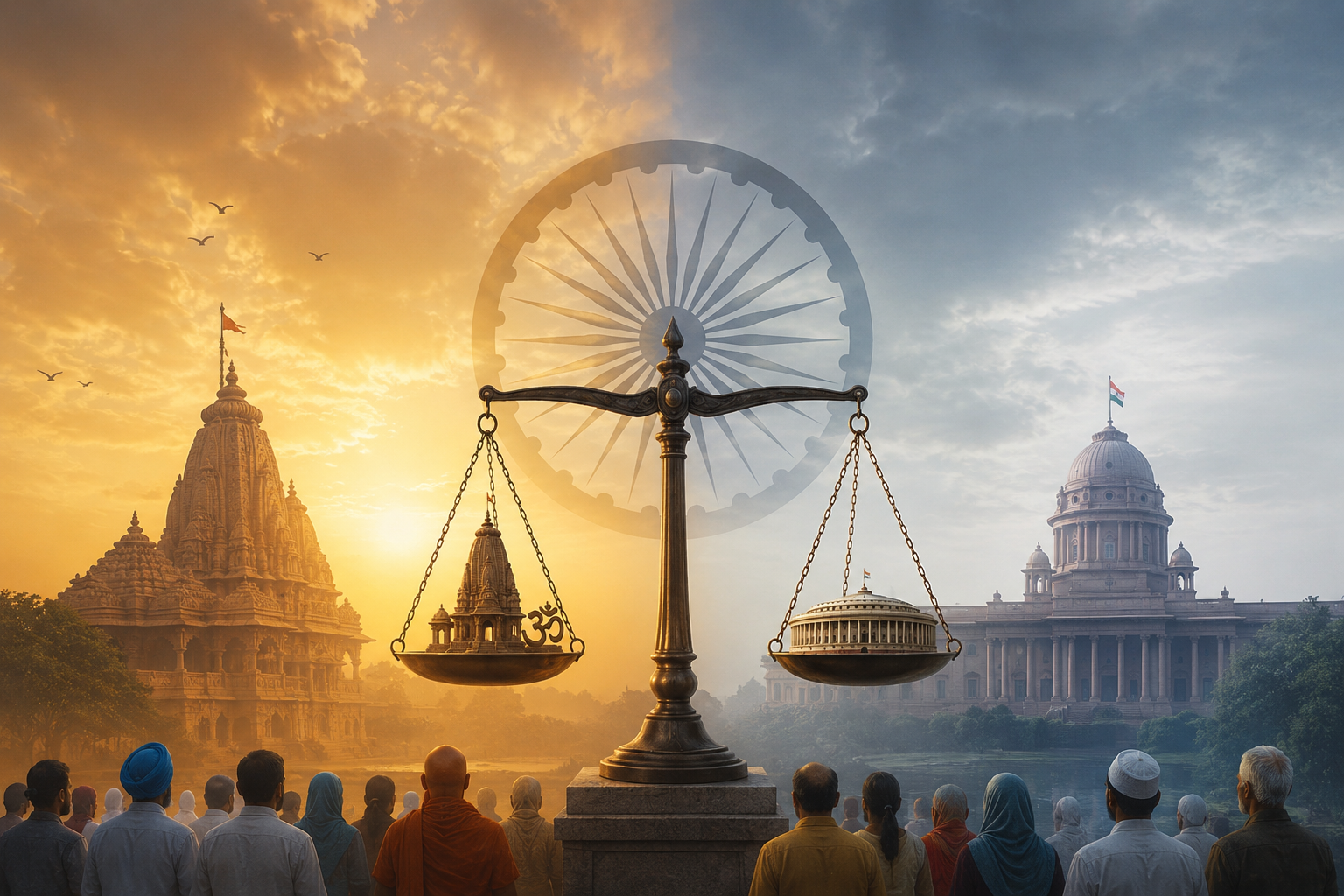
Should India Declare Hinduism as Its State Religion? Revisiting the Debate on Secularism and Hindu Rashtra
Two images of Narendra Modi, Prime Minister of the world’s most populous and constitutionally secular nation, stand out in recent memory. One is of him performing the Pran Pratishtha ceremony before the idol of Lord Ram at the newly built Ram Mandir in Ayodhya. The other is of him offering prayers at Somnath, one of Hinduism’s most revered temples dedicated to Lord Shiva.
The Prime Minister of a secular nation publicly and proudly displaying his faith before crores of Indians through television and digital media is a powerful image. For many, it raises a simple question: if this is not a reflection of a Hindu Rashtra, what is?
The Prime Minister, like every citizen, has a constitutional right to profess and practice his religion. Yet the symbolism of such acts carries political significance and inevitably raises questions about the state of secularism in India.
Historically, Indian political leaders, particularly during the Congress era, were careful to avoid overt displays of personal faith while acting in their official capacity. Although they attended religious functions, they generally sought to maintain a public image of neutrality consistent with India’s secular ethos. Narendra Modi’s public participation in major Hindu ceremonies marks a visible departure from that tradition. The BJP, unlike earlier governments, appears comfortable openly embracing its Hindu identity, reflecting a significant shift in India’s political culture.
Religion, politics and national identity
Religion has historically been one of the strongest forces shaping societies. It has inspired unity, social cohesion and moral values, but has also contributed to conflict, political mobilization and struggles for power.
History offers numerous examples, from conflicts between Catholics and Protestants in Europe to the Crusades and the Hindu-Muslim tensions that accompanied the Partition of the Indian subcontinent. Nations such as Pakistan, Israel and Iran emerged in part from religious identity and sentiment.
Religion provides a powerful sense of belonging by creating a distinction between “us” and “them.” Political leaders across the world have often used this identity to mobilize communities, build support and advance political objectives. Whether such mobilization is constructive or divisive depends largely on how religion is employed in public life.
The importance a state assigns to religion plays a significant role in determining whether it is viewed as secular, religious or somewhere in between.
State religion does not always mean theocracy
Much of the debate surrounding Hindu Rashtra stems from the assumption that declaring a state religion automatically leads to a theocratic system. However, global examples suggest that reality is often more complex.
At one end of the spectrum are countries such as Iran and Afghanistan, where religion plays a dominant role in governance and law. Iran explicitly bases its governance on Shia Islamic principles, while the Taliban’s Afghanistan enforces an even stricter interpretation of religious law.
Other countries occupy a middle ground. Pakistan identifies itself constitutionally as an Islamic state, while nations such as Malaysia and Brunei give Islam a special position within the state while continuing to operate modern governmental institutions.
The Christian world offers similar examples. The Vatican remains a true Christian theocracy under the Pope. Yet countries such as England, Denmark, Norway, Greece and Malta maintain official ties to Christianity while functioning as modern democratic states. In these countries, individual freedoms and the right to practice other religions are generally protected.
The crucial distinction is not whether a nation has a state religion, but how extensively religious doctrine controls governance. A state religion does not necessarily eliminate democracy, constitutionalism or civil liberties.
India’s unique position
India occupies a unique position in the world. It is home to the largest Hindu population on the planet and is the only country where Hindu civilization developed and flourished continuously over thousands of years.
Given this reality, many argue that India is already an undeclared Hindu state. More than three-fourths of its population identifies as Hindu, and Hindu traditions, festivals, customs and cultural practices influence public life across the country.
What appears unusual to some is that despite being the world’s largest Hindu-majority nation, India chose the path of secularism rather than declaring itself a Hindu state at the time of Independence.
The leaders of the freedom movement, particularly Mahatma Gandhi and Jawaharlal Nehru, believed that secularism was the most suitable framework for a diverse nation containing substantial Muslim, Christian, Sikh, Jain and other minority communities. They feared that defining India primarily through the identity of one community could weaken national unity in the aftermath of Partition.
At the same time, another school of thought existed. Its proponents argued that Hinduism was not merely a religion but a civilizational way of life shared by the overwhelming majority of people living in India. Groups such as the Hindu Mahasabha and other nationalist organizations believed that an independent India could legitimately define itself as a Hindu Rashtra.
Thus, even at Independence, there were two competing visions of India: one secular and the other explicitly rooted in Hindu identity.
Secularism and the constitution
Interestingly, the word “secular” did not appear in the original Constitution when it came into effect in 1950. It was added later through the 42nd Constitutional Amendment during the Emergency in 1976, which described India as a “Sovereign Socialist Secular Democratic Republic.”
Nevertheless, the Constitution always guaranteed religious freedom through Articles 25 to 28, reflecting a commitment to equal respect for all faiths.
Some constitutional scholars have argued that the framers intentionally avoided rigid separation between religion and state because such a model could have limited the government’s ability to intervene in matters affecting religious communities. Indian secularism therefore evolved differently from Western secularism, emphasizing equal treatment of all religions rather than complete exclusion of religion from public life.
The politics of secularism
The debate over secularism in India has never been purely constitutional. It has also been deeply political.
For decades after Independence, the Congress Party positioned itself as the principal defender of secularism. Its critics, however, argued that this approach often translated into minority appeasement, particularly of Muslim communities, while concerns relating to the Hindu majority were frequently dismissed as communal.
Organizations such as the RSS and later the BJP challenged this narrative. They argued that Congress practised what they called “pseudo-secularism”—a political strategy that sought to consolidate minority vote banks while portraying Hindu political aspirations as inherently communal.
The Ram Janmabhoomi movement became the defining moment in this ideological struggle. The campaign surrounding the disputed site in Ayodhya transformed Indian politics and significantly expanded the BJP’s political base. What began as a marginal political force with only a handful of parliamentary seats eventually emerged as the dominant national party.
The BJP’s success reflected the resonance of its argument among large sections of the Hindu population. Its supporters believed that expressions of Hindu identity had been unfairly stigmatized for decades under the label of communalism.
Today, the political landscape has changed dramatically. The party that once accused Congress of pseudo-secularism governs the country, while Congress now accuses the BJP of promoting majoritarian politics.
Should India have a state religion?
It is against this backdrop that the debate over Hindu Rashtra must be viewed.
Supporters of the idea argue that there is nothing inherently wrong with a country recognizing the faith of its majority population. They point out that several democratic nations maintain official religious identities while continuing to uphold democratic institutions and individual freedoms.
Their argument is not necessarily for a Taliban-style theocracy or complete integration of religious and political authority. Rather, it is for official recognition of a reality they believe already exists—that India is the only country in the world where Hindus constitute the overwhelming majority and where Hindu civilization has its deepest roots.
From this perspective, acknowledging Hinduism as a state religion would merely formalize an existing cultural and civilizational identity rather than fundamentally transform the nature of the Indian state.
The question therefore is no longer whether Hindu identity plays a role in Indian public life—it clearly does. The real question is whether India should continue with its current secular framework or begin a serious constitutional and political discussion about formally recognizing the faith of its majority population.
If countries such as England, Greece and Denmark can maintain official religious identities while remaining modern democracies, supporters ask, why should a Hindu-majority India be any different?