
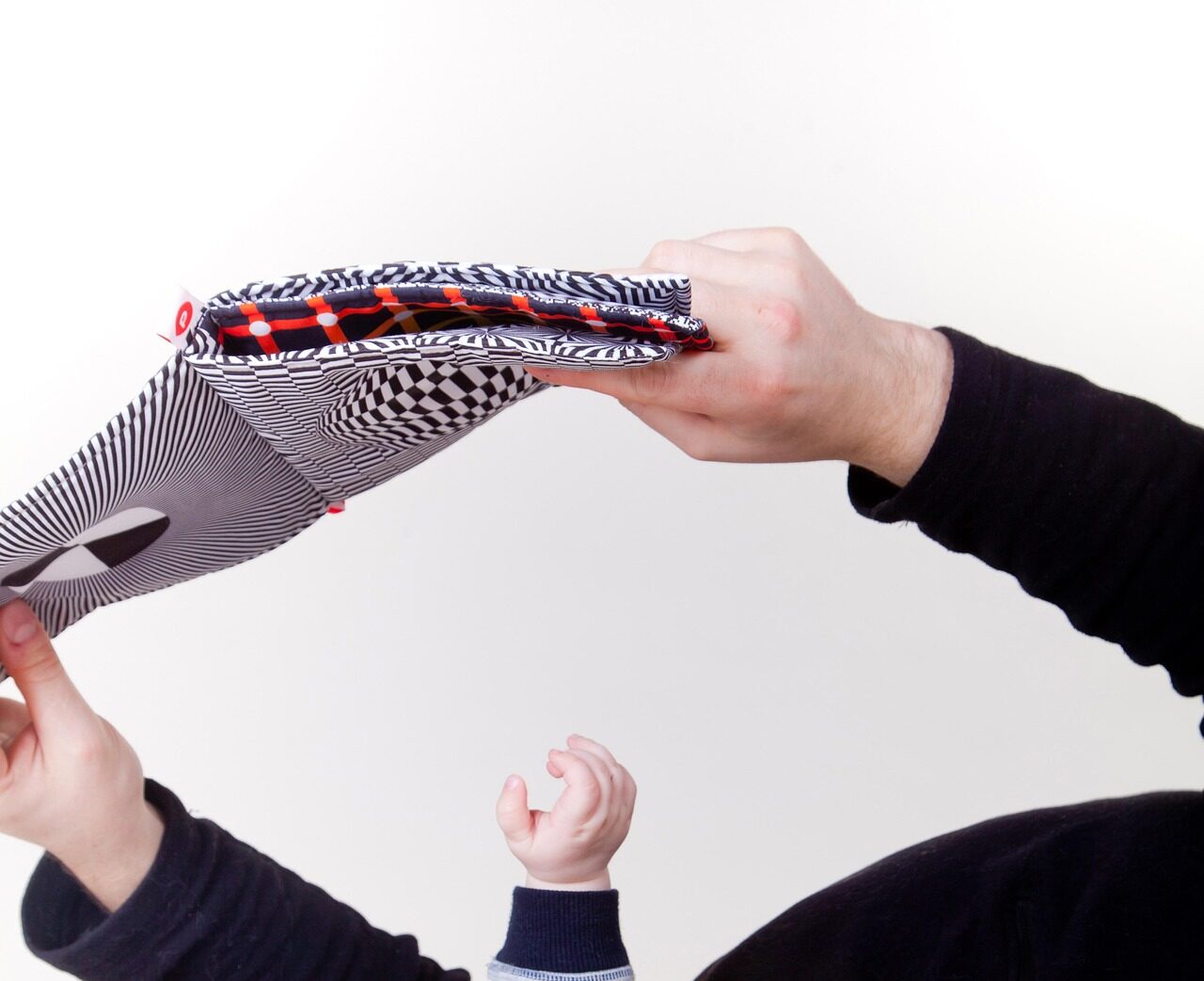
Reading a book loudly to a baby or sounding a rattle to keep the baby engaged has for past sometime been given up for keeping the child busy with sensory books.
Despite the fact that psychologists say a no to the baby being handed over the mobile phone or tablet to play as a long screen time hampers language development , digital technology is today providing a more immersive experience with AR augmented reality, three dimensional animations being made to come to life for the baby.
The sensory books are still the mainstay for large number of parents who want to keep the baby away from the “digital” world.
The tactile sense is stimulated in the sensory books with variety of textures and surfaces, the books are at times audible with sounds, and sometimes these books give different smell, besides variety of colours and shapes as a part of visual stimulation. Sensory experiences have a direct impact on neural connections and cognitive growth in young minds.
Sensory stimulation triggers the release of neurotransmitters, which facilitate the formation of new connections between neurons. These connections, known as synapses, are the building blocks of learning and memory. Sensory play provides children with opportunities to process and integrate sensory information effectively. This integration helps children to organize and make sense of the world around them, leading to improved attention, concentration, and overall cognitive abilities.
The brain has an ability to reorganize and form new neural connections throughout life known as neuroplasticity. When the baby gets innumerable sensory inputs during the early stages of its life the brain of the baby forms new neural connections at a a very early stage.
Thus sensory play has been found to play a significant role in promoting brain plasticity, particularly during early childhood. The journal Neural Plasticity said in an article that sensory experiences stimulate the release of neurotrophic factors, which support the growth and survival of neurons. This process enhances brain plasticity, allowing children to adapt, learn, and develop essential skills.
Sensory play is supposed to have a profound impact on language and cognitive development in children. Sensory experiences activate multiple regions of the brain simultaneously which helps greatly in integrating several factors coming in from different sources which helps in understanding language, problem solving and critical thinking, according to an expert.
Interestingly sensory play also relaxes and calms the child and brings about emotional regulation particularly those involving tactile exploration and deep pressure touch.
The proprioceptive sense is improved which is extremely crucial for a baby to learn in life because it relates to the sense of body position and movement. It is actually a subconscious ability strengthened during the early stages of life which gives you the ability to know where your body part is in the space without using your eyes. This sense is important for balance, controlling movement and actions.
There are special receptors called proprioceptors in the babies muscles, tendors, joints which send information to the brain of the child which interprets the information to create a continuous subconscious awareness of your body parts in space and movement. Because of this sense a baby can touch its nose with its hand without opening the eye.
The science behind sensory play provides compelling evidence of its positive impact on brain development in children. Incorporating sensory play into children’s daily routines can provide them with rich and beneficial experiences that support their overall development and well-being.
Sensory textile books are usually made of fabric materials that allow pre-school and young children to interact and play by touching and feeling them, that encourage creativity to their neurodevelopment. The books stimulate creativity, imagination, and motor skills among preschool children. At the cutting edge of this area , virtual reality books have also started though thankfully at present they are for older children with headset.