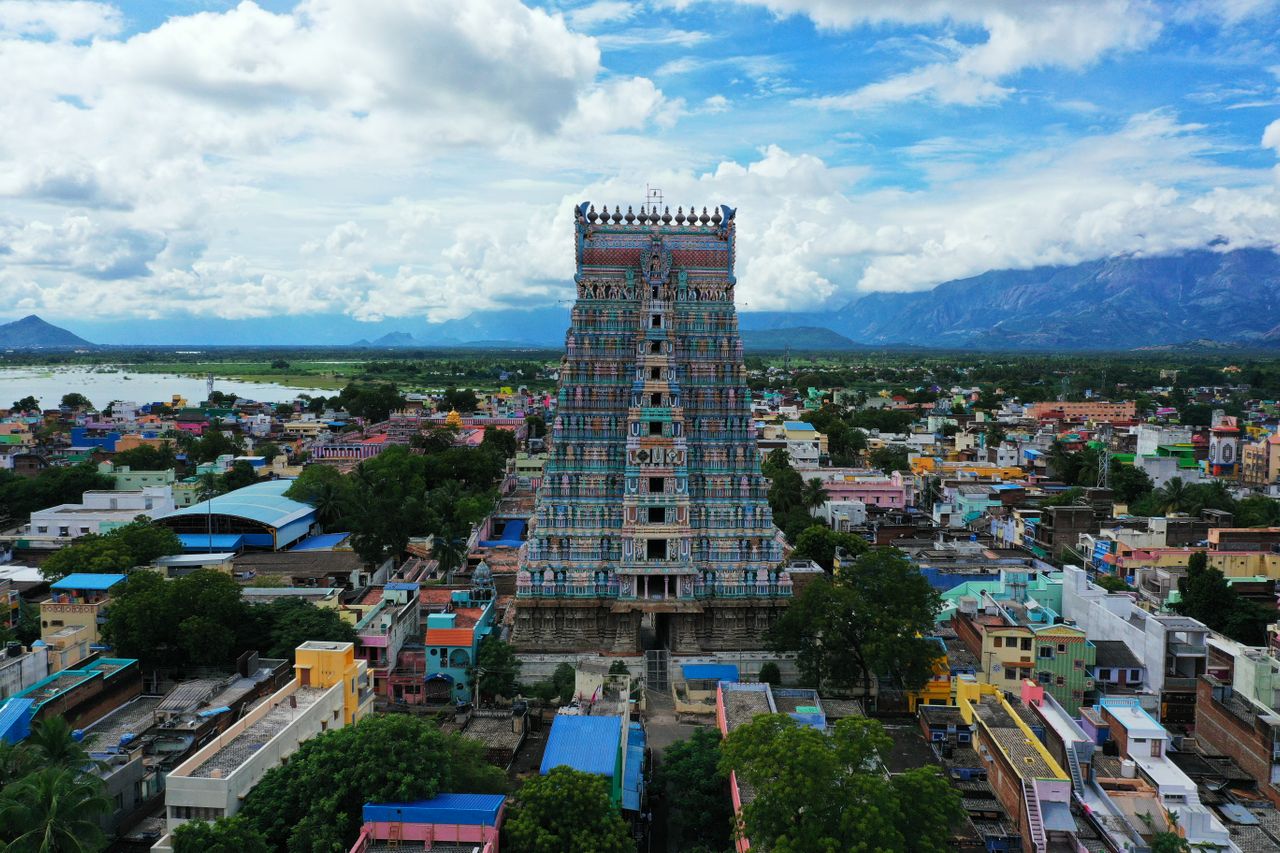
The Deepam (lamp) controversy in Tamil Nadu may clearly soar the BJP’s political strength in this southern state ? At present the BJP has just 4 seats in the 234-seat Tamil Nadu Assembly.
BJP has got a shot in its arm with the two-judge bench of Tamil Nadu high court comprising Justices G. Jayachandran and K.K. Ramakrishnan upholding the earlier order of the single judge bench and allowing the devotees of the Subramaniaswamy temple at Thiruparankundram, Madurai to ignite the deepam at Deepathoon (Stone Pillar) atop Thiruparankundram hills.
The BJP leaders including a central cabinet minister lost no time to come out and declare that the judgement has been a “slap” on the face of the anti-Hindu forces like DMK and Congress and that the people of Tamil Nadu will give them a fitting reply at the time of elections. The BJP’s political agenda is thus hidden no more.
It clearly wants to reap the advantage of being the champion of Hindu interests in Tamil Nadu like it has done in several other states.
However, with DMK being strongly entrenched in Tamil Nadu and with its deep rooted anti-Hindi and anti-Hindu bias, it is not as easy for BJP to overpower DMK in its bastion, as trouncing other parties in the Hindi belt.
The placing of Sengol, silver sceptre from Tamil Nadu in Lok Sabha and the annual Kashi Tamil Sangam meet in Varanasi, are all instances of BJP trying its level best to endear itself to the people of Tamil Nadu.
For the BJP’s political strategists West Bengal and Tamil Nadu continue to be the two insurmountable targets and they would like to exploit each and every issue there for their political advantage by polarising Hindu votes.
The court reiterated that lighting a deepam at an elevated location is a recognised religious practice and held that the temple administration was required to comply with devotees’ request to light the lamp at the Deepathoon.
The judges held that there was no conclusive legal or religious prohibition against lighting the lamp at the Deepathoon and said the appellants had failed to produce “formidable evidence” under ‘agama shastra’ barring the practice.
Thus the Deepam controversy has come at the opportune time and with the courts deciding in favour of the Hindus, BJP can really use this issue to expand their core constituency in Tamil Nadu and target the incumbent DMK government for its alleged appeasement politics by trying to stop the hindoo devotees going to light the lamp.
To exploit such communally sensitive issues is a tried and tested modus operandi of the BJP’s political strategists.
Why has the BJP clutched onto the issue of the Deepam ? It is because it has the mix of all the elements which could be exploited to the hilt for rousing communal feelings and to polarise and consolidate votes particularly in favour of the Hindus.
Now the controversy revolves around the fact of where is the flame or deepam should be lit. There are claims and counter claims being made by different groups.
While the temple authorities say that it was being traditionally lit at the temple mandapam, the present issue was raised by the Hindu Tamil Party leader Rama Ravikumar who came out with a petition and knocked the door of the High Court seeking permission to light the Karthigai Deepam (lamp) at Deepathoon (Stone Pillar) atop Thiruparankundram hill close to the temple.
The communal sensitiveness is there because there is a Dargah of muslims close to the Deepathoon and the Tamil Nadu Waqf board lays claims to the land on top of the mountain and also that the pillar belongs to it, which claims have now been rejected by the court.
On December 1 last year, Justice GR Swaminathan allowed the petition and ordered that the ceremonial lamp be lit on the festival day at Deepathoon. The reason clearly was that the faith of large number of devotees was involved.
Actually for decades this religious and property controversy involving the Subramaniya Swamy Temple and the adjoining Sikandar Badshah Dargah has been going on.
The state government had stopped the lighting of the deepam at the hilltop on the plea that it feared that it could lead to a law and order situation.
The state government had challenged the matter in the High Court which was taken up by the two judge bench. Now it delivered its verdict concurring with the decision of the single judge bench. The court has rejected the apprehensions of the state regarding law and order.
The emotionally volatile issue has already had large numbers of Hindu devotees protesting for their right to light the lamp atop the hill. There have been hunger strikes, including a protestor dying by setting fire to himself.
The two judge bench of the Madurai High Court said the issue had been “politicised unnecessarily”.
It has also said that public access to the ceremony will be restricted and will be subject to consultation with the Archaeological Survey of India (ASI) as the hill is a protected site.
While some maintain that Deepathoon is the traditional spot where the deepam has been lit continuously for over a hundred years, in accordance with established customs and Agama practices, others including the state government say that there was no conclusive proof to establish the existence of a lamp pillar on the hilltop.
The site of the Deepam ritual became contentious only in 1994, when a devotee approached the Madras High Court, seeking to shift the ceremony from the Uchipillar Kovil mandapam at the temple to Deepathoon, on the hilltop and close to the dargah.
The Madras High Court, in 1996, ordered that the Deepam be lit in the traditional place of the mandapam at Subramaniaswamy temple.The temple administration has consistently maintained that the mandapam is the traditional place for the ritual and that the practice has been ongoing there for a century, in line with its agamic norms.
As far as the ownership of the land on the hill is concerned even before Independence, the Privy Council in 1931 had demarcated the ownership on the hill: the Dargah and its immediate adjuncts were declared to belong to the Muslim community, while the rest of the hill vested in the Subramania Swamy Devasthanam.
In its present order the court also dismissed claims made by the Waqf board that the pillar belonged to the Dargah, as also a claim that the pillar was a survey stone.
How long will the BJP be able to “politically” keep the issue alive and how far will it benefit BJP in the hustings will have to be seen in the future?

Views | News | Opinions
Views | News | Opinions