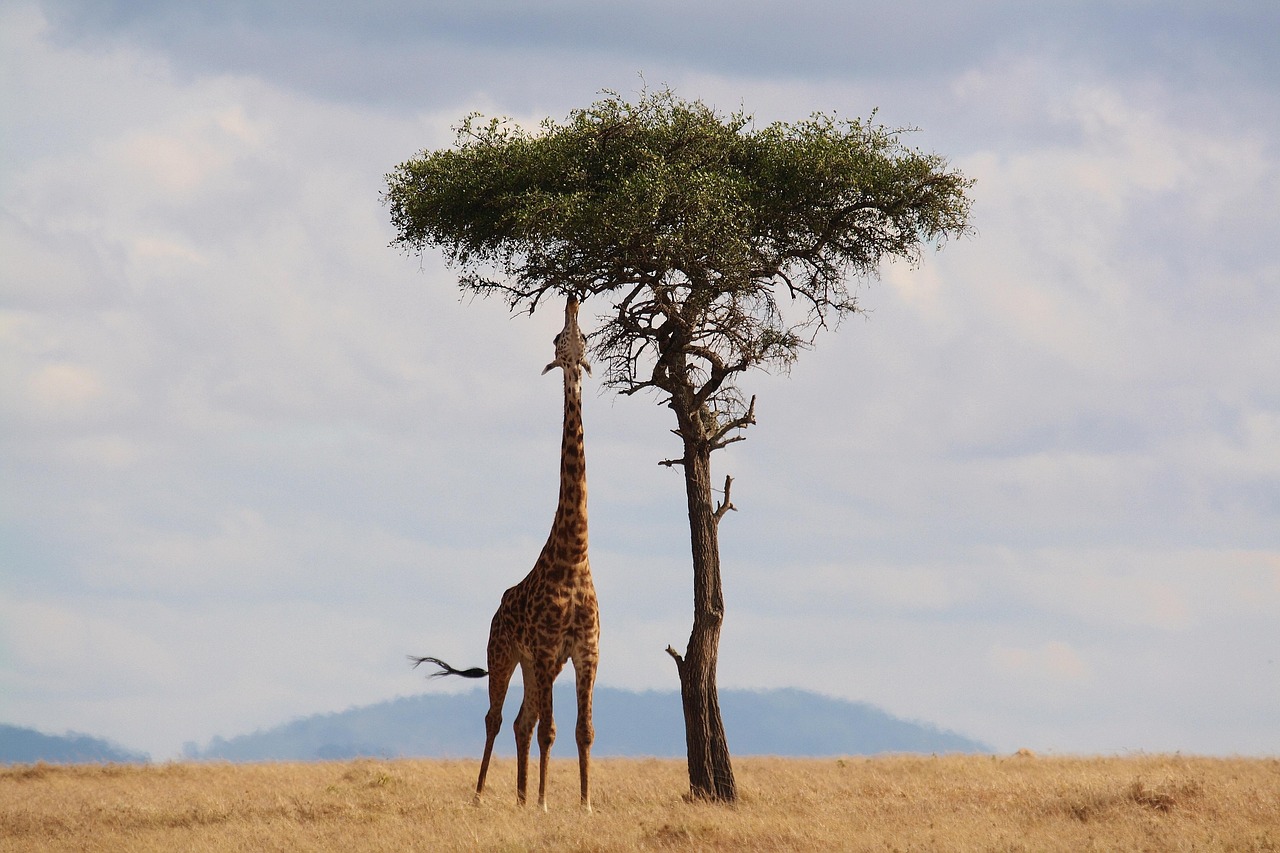
The population of giraffe the tallest land animal with the unique long neck only found in Africa, is coming down sharply.
If immediate steps are not taken to protect this beautiful animal, it will disappear from the world.
Giraffe are still vulnerable to extinction according to the IUCN (International Union for Conservation of Nature) Red List of Threatened Species.
Their nearly 18 feet height allows them to see far across open landscapes and there is loss of wide open spaces where they can freely graze at the leaves on the tree tops.
A giraffe’s neck can stretch over six feet long.This unique feature evolved over millions of years as shorter necked giraffes died out unable to eat leaves from top of tall trees. The taller necked ones not only ate from top of trees were also able to spot predators from a distance and flee to save themselves.
In the open savannas of Africa, tall trees such as acacia and mimosa provide a crucial source of food. By growing taller, giraffes gained access to leaves that other herbivores could not reach, reducing competition and ensuring a steady supply of nutrition even during dry seasons.
Thus the long necked giraffes survived and passed on this unique feature to their offsprings. Giraffes developed their long necks through gradual adaptation over millions of years.
Even today giraffes spend most of their feeding time at heights above ten feet, far beyond the reach of antelopes or zebras.
Having such a long neck might look effortless, but it requires special adaptations to work. Despite their height, giraffes have only seven neck bones, just like humans. The difference lies in their size, as each vertebra on average is more than ten inches long and connected by powerful joints that allow flexibility and support.
Their circulatory system is remarkable ,a giraffe’s heart can weigh more than 20 pounds and generate twice the blood pressure of a human heart. This strength is necessary to pump blood up the six-foot distance to the brain. Special valves in their neck arteries prevent blood from rushing back down when they lower their heads to drink, protecting them from fainting or injury.
Even their tissues help them manage the strain of being so tall. The skin and fascia on their legs are packed tight, which keeps blood and fluid from pooling.
The National Aeronautical and Space Agency has actually studied the anatomy of baby giraffes to help them develop devices for space astronauts. Baby giraffe use legs within hours of birth despite long inactivity in the womb.
Giraffe leg veins inflate right after birth to get the baby’s legs working.
As similar problem used to be faced by astronauts when they returned to earth and its gravity after the weightlessness of space. After studying giraffe babies NASA has developed a device to spacesuits to force blood around an astronaut’s legs called the Lower Body Negative Pressure Process.
According to fossil record ancient giraffe relatives, such as Samotherium, had much shorter necks. These early species lived about seven million years ago before giraffes evolved their modern form.
Giraffe reproduce slowly with mother giraffes being pregnant for about 15 months and give birth to only one calf at a time. The average female giraffe will have five calves throughout her lifetime but only 50 per cent survive to adulthood.
It is estimated that giraffe population globally is down by nearly 40 percent over the last few decades. Though with over a lakh of giraffe population in the wild one cannot say the species is at the brink of extinction but the growing decline of population is alarming.
Poaching of giraffe for meat, skin and bones is are the major reasons for the reduction of giraffe population besides development , civil war among African nations and climate change . Tanzanians believe the body parts can cure victims of HIV-AIDS quite prevalent in Africa.
Nubian and Kordofan giraffes have become critically endangered. The Kordofan giraffe has lost 90% of its population since the 1980s, and the Nubian giraffe has lost 98%.
Giraffe Conservation Foundation is the only NGO in the world that concentrates solely on the conservation and management of giraffe in the wild throughout Africa. They are dedicated to securing a future for all giraffe populations in the wild.
According to them the giraffe numbers have fallen from 140,000 to 80,000.
Giraffes are found in 21 African countries, including Chad, Botswana and Somalia. Their range stretches from Niger to South Africa.
Other reasons for the decline of giraffes include their confinement to enclosed areas and a reduction in food availability, especially acacia trees.
Legislation to restricting hunting has been put in place by some countries but many people continue to hunt wildlife illegally.
While conservation focus has been to protect rhinos and elephants, giraffe seems to have been left out.
Several organisations have now started campaigning for giraffe conservation.
Some species like the Rothschild giraffe and the West African giraffe, have only a few hundred left in the wild.
The IUCN Red List classifies giraffe as vulnerable with the sub species like the reticulated giraffe and the Masai giraffe—are classified as endangered. The Masai giraffe is also endangered.
According to one estimate there are only 45,400 Masai giraffes,11,048 reticulated giraffes,10,173 Angolan giraffes,1,400 Kordofan giraffes,1,399 Rothschild’s giraffes,
455 455 Nubian giraffes,425 West African giraffes,420 Thornicroft’s giraffes left in the wild.
Under the Convention on International Trade in Endangered Species of Wild Fauna and Flora (CITES), Giraffes have been Appendix II protections, which means they are considered threatened but not necessarily threatened with extinction—though they could be if trade is not strictly regulated.
Poachers hunt giraffe for their bones which are traded for carving and trophies made of giraffe bones.
According an estimate more than 3750 giraffes were killed and 40,000 items from these were sent to the US.
In 2019, giraffes were given protection against trade under CITES.

Views | News | Opinions
Views | News | Opinions