
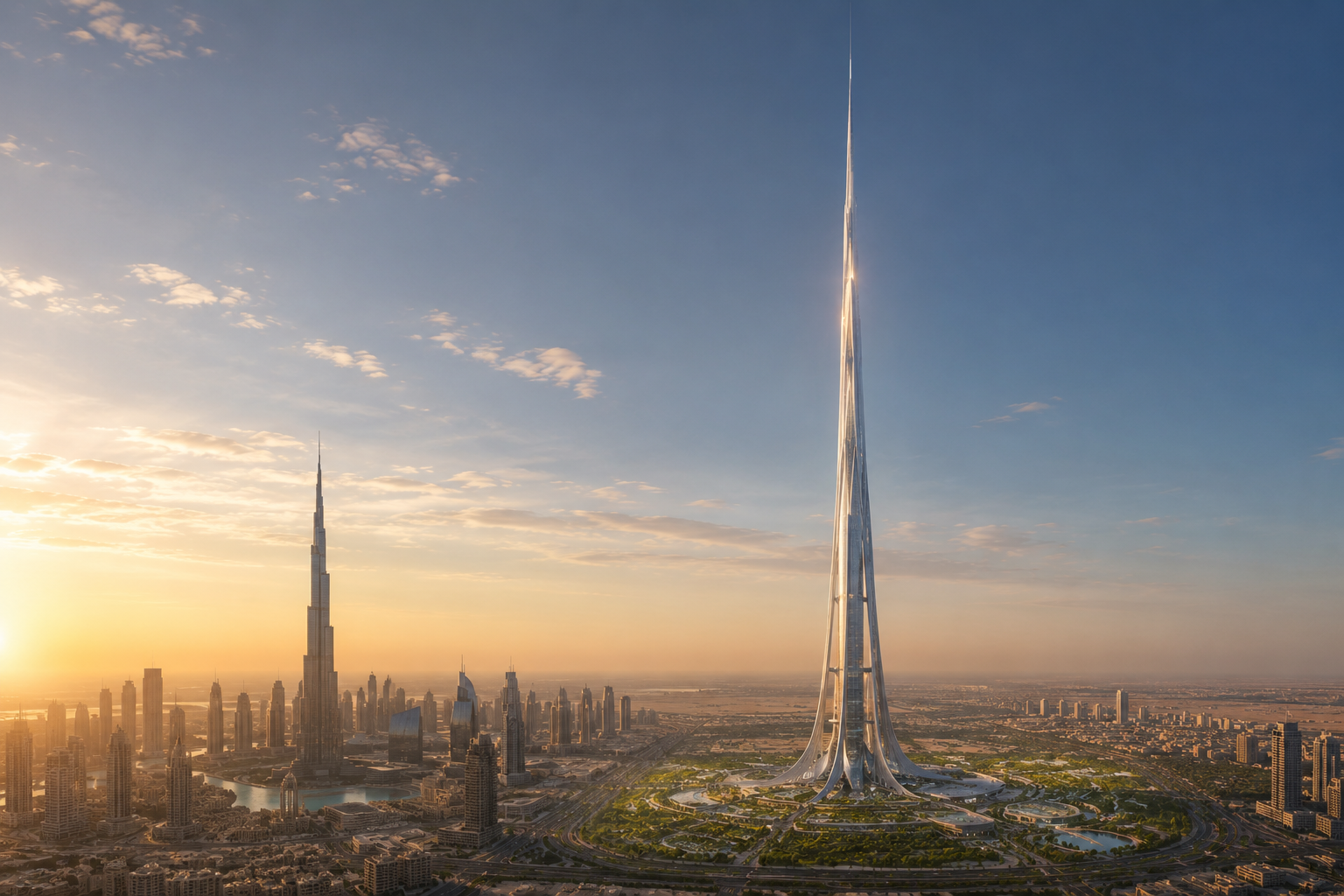
The race to build the world’s tallest skyscraper is entering a new era. Dubai’s iconic Burj Khalifa, currently the tallest building on Earth, may eventually lose its crown to an ambitious new project in Saudi Arabia. Known as the Rise Tower, the proposed megastructure in Riyadh aims to reach an astonishing height of nearly two kilometres, making it more than twice as tall as the Burj Khalifa.
With an estimated construction cost of around $5 billion, Rise Tower represents one of the most ambitious engineering projects ever conceived. If completed, it would redefine the global skyline and become a symbol of Saudi Arabia’s economic transformation under its Vision 2030 strategy.
What is Rise Tower?
Rise Tower is a proposed supertall skyscraper planned for Riyadh, Saudi Arabia. The structure is expected to be located in the North Pole District, a massive 306-square-kilometre urban development situated north of Riyadh near King Khalid International Airport.
The project is being designed by the internationally renowned architectural firm Foster + Partners for Saudi Arabia’s Public Investment Fund. The tower is envisioned as a futuristic “vertical city” that could accommodate residential apartments, luxury hotels, offices, cultural spaces, retail facilities, entertainment venues and observation decks within a single structure.
With approximately 678 floors planned, Rise Tower would become one of the most complex buildings ever designed.
Part of Saudi Arabia’s Vision 2030
The project forms part of Saudi Arabia’s Vision 2030 initiative, a long-term national strategy aimed at diversifying the economy, reducing reliance on oil revenues, attracting foreign investment and positioning the Kingdom as a global destination for business, innovation and tourism.
Just as the Burj Khalifa transformed Dubai into a globally recognized city, Rise Tower is intended to serve as a landmark representing Saudi Arabia’s future ambitions.
Engineering Challenges of a 2-Kilometre-Tall Building
Constructing a building that approaches two kilometres in height presents engineering challenges unlike any faced before.
One of the greatest obstacles is wind. At extreme altitudes, powerful wind currents can create vibrations and structural movement that may affect both the stability of the building and the comfort of occupants. Engineers are therefore exploring aerodynamic designs that allow wind to flow around the structure rather than directly striking it.
Advanced computational modelling and simulation technologies are being used to predict how the tower would behave under various weather conditions and environmental stresses.
Advanced Materials and Structural Innovation
To support a structure of this scale, engineers are evaluating next-generation construction materials, including carbon fibre-reinforced concrete and other high-strength composites.
The tower may also incorporate sophisticated vibration-control technologies such as tuned mass dampers, which are designed to counteract building sway caused by wind. These systems have already been used successfully in several of the world’s tallest buildings, but Rise Tower would require them on an unprecedented scale.
Sustainability and Smart Building Technology
Rise Tower is expected to integrate a range of sustainable technologies aimed at reducing environmental impact and improving energy efficiency.
Potential features include:
- Photovoltaic solar cladding to generate renewable energy.
- Integrated wind turbines that could harness high-altitude wind currents.
- Green sky gardens distributed throughout the structure.
- Intelligent energy management systems.
- Advanced water conservation and recycling technologies.
- Real-time monitoring of security, energy consumption and building operations.
The project’s objective is to move toward a net-zero energy footprint while setting new benchmarks for sustainable skyscraper design.
The Challenge of Building the World’s Strongest Foundation
Perhaps the most critical engineering challenge lies below ground.
Supporting a building nearly two kilometres tall would require a foundation capable of carrying the heaviest structural load ever created by humans. Traditional deep foundations alone may not be sufficient.
Engineers are expected to design a massive load-distribution system that spreads the weight across a broad area while anchoring deeply into Riyadh’s underlying geology. Extensive geotechnical studies will be required to assess soil conditions and determine the most suitable foundation design.
Future Transportation Inside the Tower
Conventional elevators may struggle to efficiently serve a skyscraper of this scale. As a result, engineers are exploring next-generation vertical transportation systems.
One possibility is magnetic levitation (maglev) elevator technology, which allows elevator cabins to move vertically and horizontally without traditional cables. Such systems could significantly improve travel times and passenger capacity within a building of unprecedented height.
How Rise Tower Compares with Other Tall Buildings
The Burj Khalifa in Dubai currently stands at 828 metres (2,717 feet) and has held the title of the world’s tallest building since 2010.
Other notable skyscrapers include:
- Merdeka 118 in Kuala Lumpur, standing at 679 metres (2,227 feet).
- Shanghai Tower in China, reaching 632 metres (2,073 feet).
Rise Tower would dramatically surpass all existing skyscrapers and establish an entirely new category of supertall construction.
The Future of Vertical Cities
As urban populations continue to grow and land becomes increasingly scarce, projects such as Rise Tower raise important questions about the future of city development.
Could ultra-tall vertical cities provide a sustainable solution for accommodating millions of people while minimizing land use? Or will the immense costs and engineering challenges limit such projects to symbolic landmarks?
While Rise Tower remains in the proposal stage, construction is expected to begin in the coming years, with major phases targeted for completion by 2030. However, due to the project’s extraordinary scale and complexity, full realization could extend well beyond that timeline.
Whether ultimately completed or not, Rise Tower represents one of the boldest architectural visions ever proposed and offers a glimpse into the future of urban development, engineering innovation and sustainable skyscraper design.